The East Side Gallery is the most direct way to see a long stretch of the Berlin Wall without separating it from the city around it. Instead of a five-minute stop at the kiss mural, set aside about 1 hour to walk its 1.3 km, notice the position of the river, and understand why paintings made in 1990 speak as much of freedom as of a border that was deadly.
What the East Side Gallery is and how to get there
The East Side Gallery is a preserved stretch of roughly 1.3 km of the Wall, on Mühlenstraße in Friedrichshain. It sits between the Ostbahnhof area and the Oberbaumbrücke, which is why it works so well as a linear walk: enter at one end and exit at the other, without doubling back.
There’s no ticket to see the Wall. The visit is outdoors, and what takes planning is the pace: the stretch is long, people stop in front of the most photographed murals, and the open-air exhibition’s captions help keep the walk from turning into a “selfie collection.” Arriving via Ostbahnhof is practical if you want to start from the western end; the Oberbaumbrücke end, near Warschauer Straße, gives you a natural exit into the neighborhood.
How this stretch explains Berlin’s division
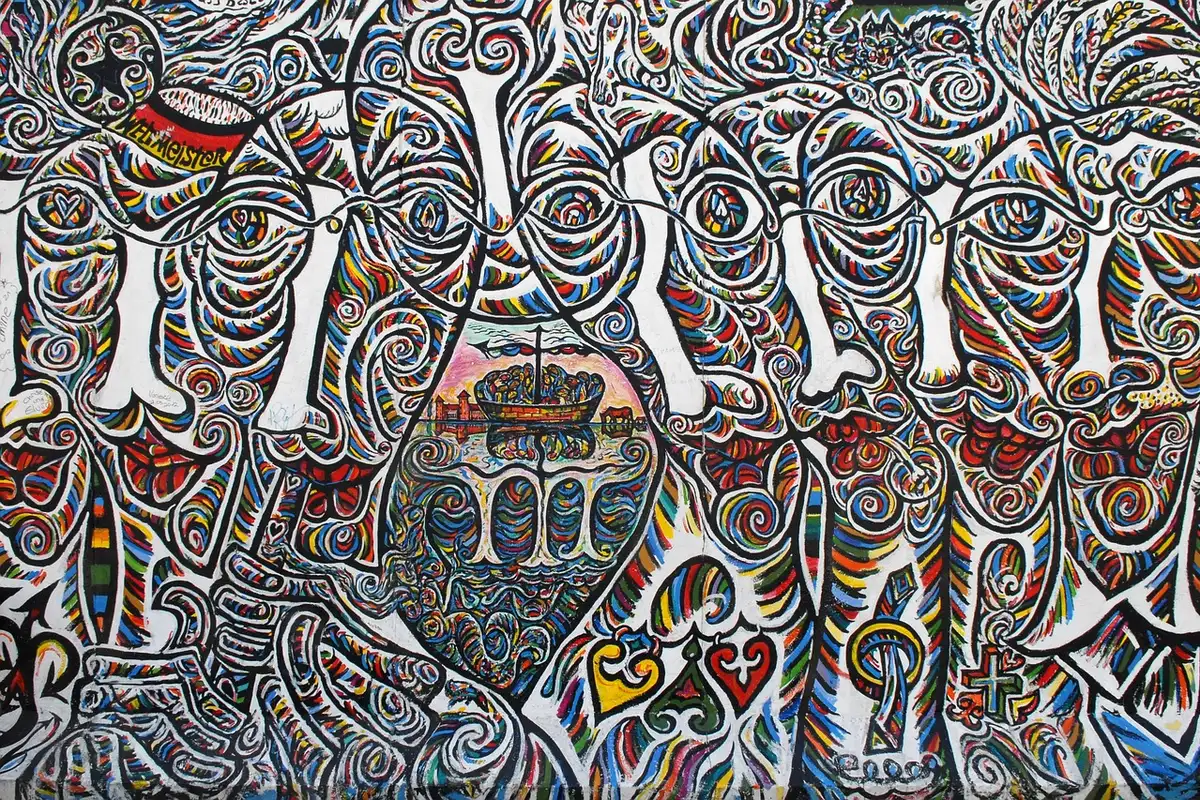
The gallery doesn’t show the side of the Wall that Western tourists used to graffiti before 1989. This was the eastern side of the barrier. After the Wall fell, 118 artists from 21 countries painted here between February and September 1990, creating works about hope, fear, peace, and the political change still unfolding.
The detail that gives the story its scale is across the street: nearby, the Spree was part of the border logic itself. visitBerlin’s documentation explains that the opposite bank in Kreuzberg was the sector boundary, while the river served the function that the border strip served elsewhere. That’s why the open landscape by the water shouldn’t be read as mere pretty scenery.
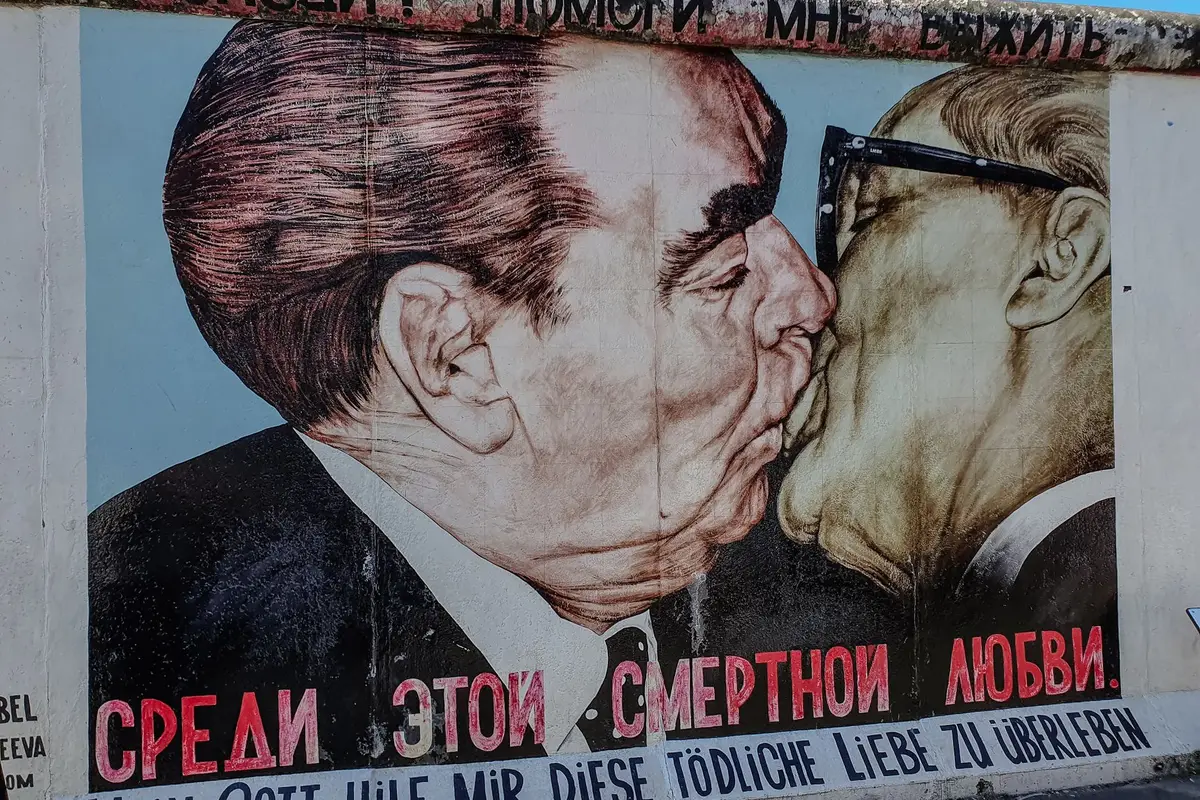
Look for two works as a starting point, not as the whole list: Dmitri Vrubel’s Bruderkuss turns the kiss between Honecker and Brezhnev into an image of East Germany’s political dependence; Birgit Kinder’s Trabant that seems to burst through the concrete turns the Wall from obstacle into passage. Both make more sense when you take in the whole set, including lesser-known paintings and restored sections.
How to walk the East Side Gallery without rushing through it
Walk the whole thing in one direction and treat the 1.3 km as a sequence, not as two isolated murals. visitBerlin’s FAQ suggests 1 hour for the East Side Gallery; that’s a good minimum for stopping, reading, and taking photos. At busy times, add a little extra just to move around without blocking the flow near the most popular works.
Starting at the Oberbaumbrücke makes the bridge your first visual reference and ends you near Ostbahnhof; doing it the other way puts the Wall right at the start and makes it easier to catch a train afterward. Both directions work. What matters is walking on the Mühlenstraße side, where the murals are, and alternating between looking at the images and taking in the river and the surrounding spaces: that spatial relationship is what turns the gallery into a historical document.
How to fit the visit into your day in Berlin
The East Side Gallery fits nicely into an afternoon in Friedrichshain-Kreuzberg, especially if your itinerary already passes through the Oberbaumbrücke. For a broader historical overview before deciding on other stops, read the history of the Wall, museums, and contemporary culture in Berlin; for a longer stay, the 7-day Berlin itinerary helps spread out the historical sites instead of cramming them into the same period.
If your goal is to understand the division, complement the visit with another point along the former Wall route rather than trying to see everything at once. The gallery shows the moment right after the opening: art, celebration, and memory layered onto a structure that had just stopped serving as a border.
Leave with one simple decision: if you only have an hour, walk the entire stretch and pick a few works to look at slowly; if you have more time, use the end of the route to follow the Spree banks or connect the visit to another memorial. The value of the East Side Gallery lies precisely in not separating the painting from the place where it exists.