 Marcelo Oliveira
Marrakech is the kind of destination that confuses you on day one and wins you over by day three. Morocco’s red city packs a medieval medina, souks branching into dozens of alleyways, squares that transform at dusk, and riads hiding silent courtyards behind unassuming doors—all within a square of ochre walls. This guide is for anyone who wants things to do in Marrakech without blowing money on tourist traps, without getting genuinely lost in the souks, and without falling for the overpriced dinner that leaves you with a stomachache.
Hotels in Marrakechfree cancellation options onlySee hotels ›Booking.com partner (advertising): we may earn a commission at no extra cost to you.
For a first trip, three full days in the city are enough: one for the medina and Jemaa el-Fna, one for palaces and gardens, and one for an escape to the Atlas Mountains or the Agafay Desert. If you have extra time, a fourth day is perfect for Essaouira or the Ouzoud Waterfalls. Anything less feels rushed; anything more calls for a stint in the Merzouga Desert.
How to get to Marrakech
Travelers from Brazil fly to Marrakech via Lisbon, Madrid, Paris, or Casablanca. There are no direct flights from Brazil; the quickest connection is usually Lisbon with TAP, landing at Menara Airport (code RAK), about 6 km from the center. The good news is about the visa: Brazilians don’t need a visa for Morocco for tourist stays of up to 90 days—just a passport valid for at least 6 months and proof of accommodation at immigration control.
From Menara to the center, the official taxi is the beige petit taxi—the gray ones are a different category and don’t operate from the airport. The taxi counter is before the main exit: ask for the price in dirhams before getting in and refuse “dollars only”—the fixed fare to the medina is around 150 to 200 MAD. Uber and Bolt have limited service at the airport but work well for getting around the city afterward. Bus line 19 connects Menara to Jemaa el-Fna for under 40 MAD, with luggage tolerated.
Inside the medina, forget the car. The streets are narrow, GPS glitches, and alleyways change names every block. The right move is to walk on foot using your hotel as a reference and rely on offline Google Maps. Outside the medina, for neighborhoods like Guéliz (modern Marrakech) and Hivernage, the gray petit taxi does the job—always with the meter on or a price agreed on beforehand.
Best time to visit and how long to stay
The ideal window is March through May and September through November, when temperatures sit between 20 °C and 28 °C and you can walk all afternoon without suffering. June through August is the truly hot season: Marrakech easily tops 40 °C, and peaks of 45 °C aren’t rare. December through February is mild by day (15–20 °C) and chilly at night, which pairs well with a riad fireplace but gets in the way if your plans include a snowy Atlas.
Keep an eye on the Ramadan calendar: in 2026, it starts around February 18. Marrakech still welcomes tourists, but many restaurants close during the day, and eating, drinking, or smoking in public before sunset is considered rude. On the flip side, late afternoon turns into a celebration with iftar. If the timing worries you, check the official calendar closer to your trip.
On duration: three full days in the city let you see the essentials without rushing. Add a day for the Agafay Desert or the Atlas, plus another for Essaouira, and you’ve got a solid week. If you want to tack on Fez, Chefchaouen, and the Merzouga Desert, set aside 10 to 14 days for Morocco as a whole—Marrakech becomes the base of a route, not a standalone destination.
What to see: medina, palaces, and gardens
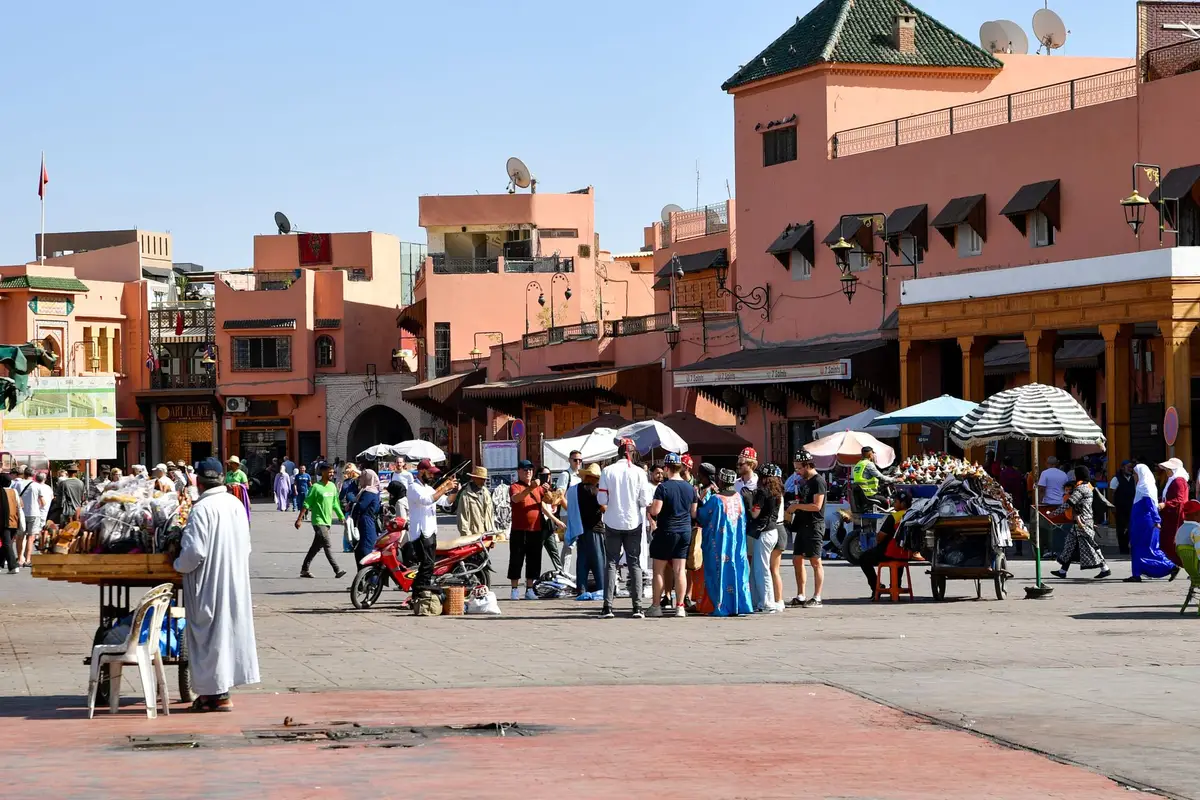
Jemaa el-Fna, a UNESCO Intangible Cultural Heritage site, is the heart of the medina and the one spot where the whole city comes together. By day it looks like a parking lot with juice stalls; by afternoon, storytellers, snake charmers, and monkey handlers arrive; after 6 p.m. it turns into a food fair with dozens of tents. Just never agree to a photo without settling the price first: you’ll be charged per shot, and the demands can get aggressive.
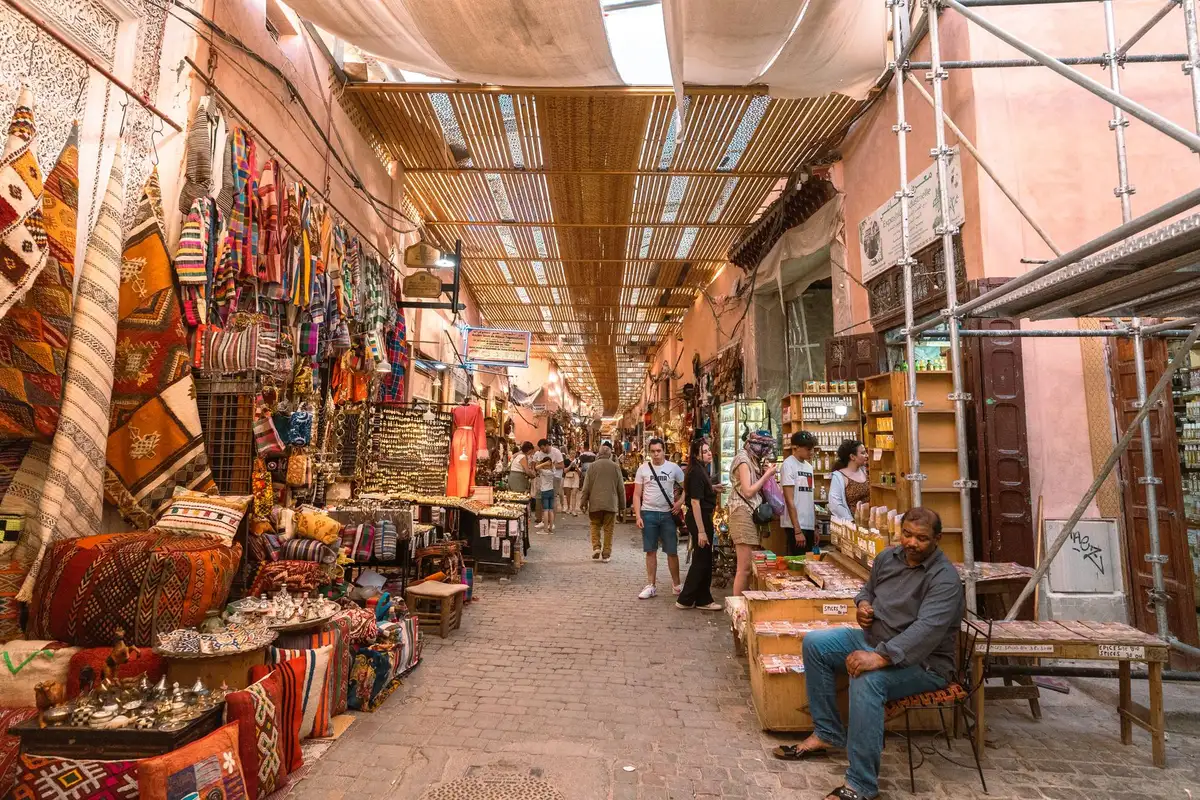
North of Jemaa, the souks begin, divided by craft: Souk Semmarine (textiles), Souk Attarine (spices), Souk des Teinturiers (dyeing), and Souk Haddadine (metals). Here’s the golden rule: prices are almost never marked, so always negotiate. Start at 30–40% of the asking price and settle around 50–60%. And watch out for the classic tanneries scam: young men approach offering a “free guide” to a tannery “open only today,” then charge you on the way out, pushing leather bags as a “tourist fee.” Better to go on your own or with a guide booked through your hotel.
The four must-see paid attractions are the Ben Youssef Madrasa (the former Quranic school, restored with a breathtaking central courtyard covered in zellige tilework), the Bahia Palace (from the late 19th century, with open courtyards and carved ceilings), the Saadian Tombs (rediscovered in 1917 and tiny, but with a mausoleum decorated to the last inch), and the Majorelle Garden with the Yves Saint Laurent Museum next door. Tickets are cheap individually—each attraction runs between 70 and 140 MAD (as of July 2026)—but they add up if you want to do everything in a single day.
For a first walk without tripping over a fake guide, a free tour with an official guide in Portuguese or Spanish does the trick. It helps you understand the medina’s logic, shows you the three or four main streets, and explains who’s who in the marketplace—which saves you from wasting money in the days that follow:
Booking the free tour of Marrakech in Spanish usually comes out cheaper than hiring a private guide at your riad’s doorstep and covers the medina’s main highlights in about two hours.
 Partner · Civitatissee all activities in Marrakech ›
Night in the Agafay Desert
Rating 9.4 · 7,554 reviews on Civitatis
- See ›Marrakech Free Walking TourRating 8.3 · 238 reviews on Civitatis
- 3-Day Merzouga Desert TourRating 9.4 · 8,178 reviews on Civitatisfrom€119per personSee ›
- Ouzoud Waterfalls Day TripRating 9.1 · 6,935 reviews on Civitatisfrom€20per personSee ›
- Northern Marrakech Hot Air Balloon RideRating 8.9 · 195 reviews on Civitatisfrom€130per personSee ›
Civitatis prices on 28/09/2026, from, per person. They may change. Want to compare? Activities in Marrakech on GetYourGuide ›
What to combine: desert, Atlas, and Essaouira
Marrakech works great as a base for day trips. The choice depends on how much time you have left and how much travel your body can handle.
The Atlas Mountains start less than an hour’s drive away: the Ourika and Imlil valleys make for a day of easy hiking, tea with Berbers, waterfalls, and riverside tables. In November and April, you can often spot snow-capped peaks in the distance—a rare sight for anyone picturing only desert. The Agafay Desert, closer (40 minutes by car), is rocky and lacks the giant dunes you see on Instagram, but it delivers on the craving for silence, ATV rides, and a camp dinner with a Berber show without needing two nights away from the city.
The Merzouga Desert, with the Erg Chebbi dunes, is the classic postcard shot. The catch is the distance: it’s an 8–10 hour drive each way, which requires at least 3 days outside Marrakech (2 nights on the road + 1 at the camp). If this is the anchor experience of your trip, plan a circuit with a night in Ait Ben Haddou and Ouarzazate along the way. If your goal is just to soak in the desert landscape, Agafay does the trick in a single day:
a full-day Agafay Desert tour with dinner and a show is usually the go-to choice for anyone with only 3 or 4 days in Marrakech who still wants that “desert on the table.”
Essaouira, on the Atlantic coast, is a 2.5-hour drive away. It’s a white-and-blue port city, breezy, with grilled fish on the pier and a smaller, less aggressive UNESCO World Heritage medina than Marrakech’s—a good antidote if you’ve had your fill of souks. Only do a day trip if you absolutely have to: spending one night changes the entire experience. The Ouzoud Waterfalls, 3 hours north, are worth the full day only if you love hiking and water—the journey is long compared to the time you actually spend at the destination.
Where to eat without getting sick
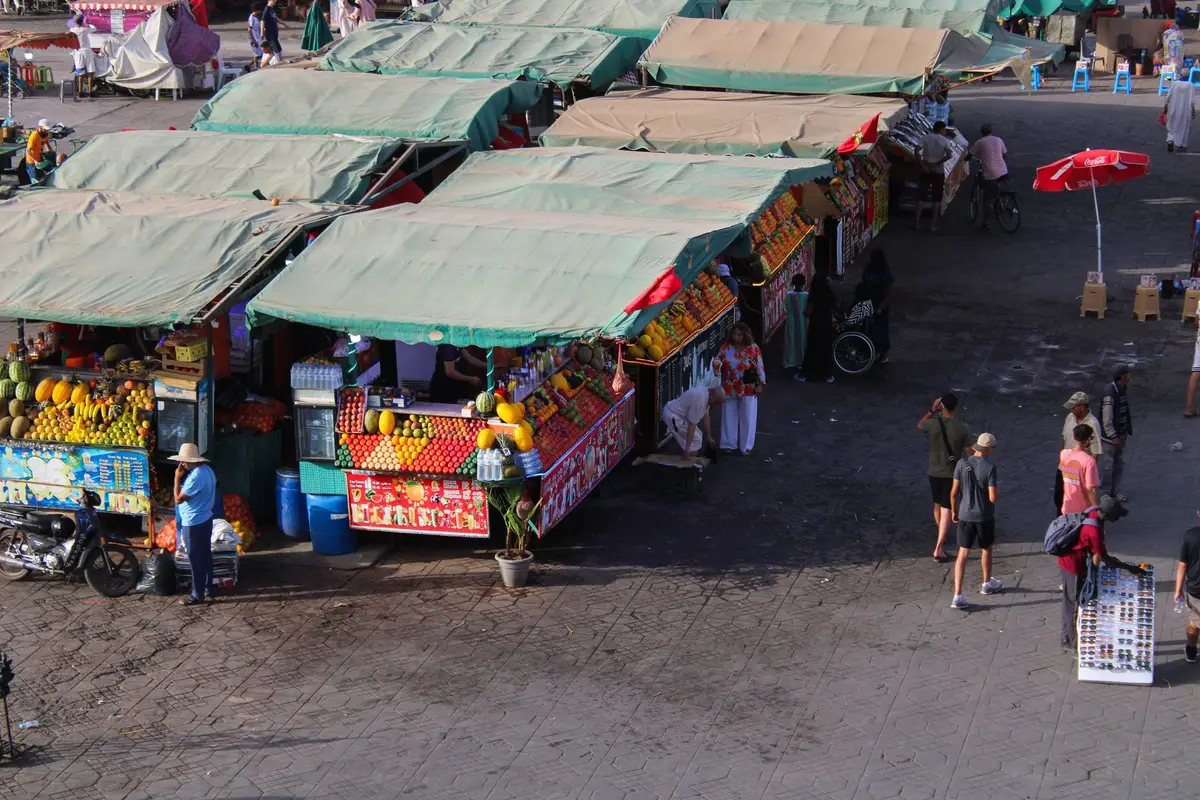
Eating in Marrakech splits tourists into two camps: those who surrender to Jemaa el-Fna and those who steer clear. The square’s food stalls (with painted numbers, like “Chez Aicha, stall 14”) are pure theater, but the food turnover, the heat, and the pushy waiters usually make for a better story than a decent meal. If you go, eat early in the evening when the food has just come out, pick a stall packed with locals, and skip the seafood (the coast is far away).
For reliable lunches and dinners, the move is to book a table at riad terraces. Well-established spots like Nomad, Le Jardin, and Café des Épices run between 200 and 400 MAD per person (Jul 2026) and serve properly made tagine and couscous with views over the medina from above. In Guéliz, contemporary restaurants like Amal (a social kitchen run by women in training) and Al Fassia (with a classic menu) are worth the 15-minute taxi ride. Always ask for sealed bottled water; skip ice in drinks outside of restaurants.
A great trick for understanding the cuisine before you pick a restaurant is a Moroccan cooking class in a riad—in three hours you’ll grasp the logic of tagine, ras el-hanout, and the bread that appears on every table, and you’ll know what to order afterward. Renting a riad with a Berber kitchen is usually cheaper than a gala dinner at a luxury hotel.
Where to stay: riad or modern hotel
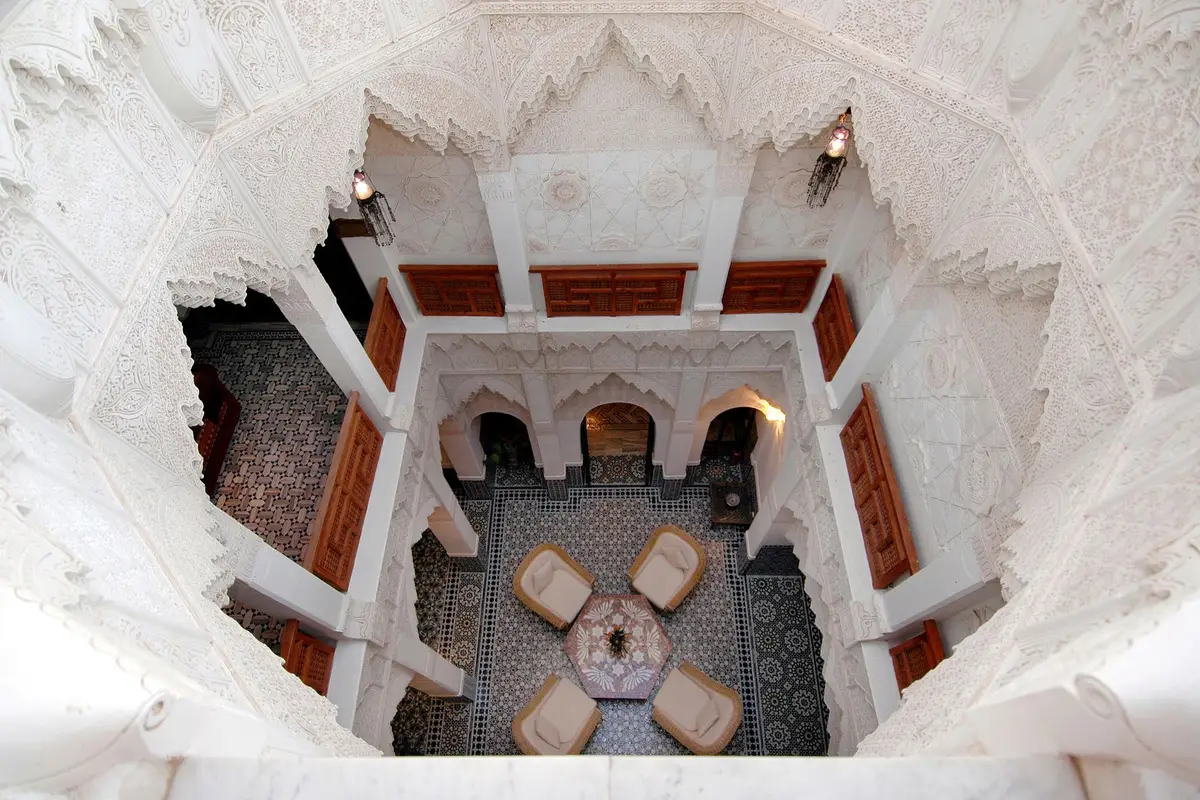
The big decision in Marrakech is medina or new city. Sleeping inside the medina, in a riad—the traditional Moroccan house with an interior courtyard, usually 4 to 10 rooms—is the postcard experience: a discreet door on a narrow alley, absolute silence inside, breakfast in the courtyard with bergamot. The trade-off is that taxis don’t reach your door (the driver drops you at a corner and a porteur carries your luggage through the alleys), and finding your way back at night can be confusing the first few times.
Neighborhoods that tend to work well inside the medina: Kasbah (quieter, near the Bahia Palace), Mouassine (well-located, between Jemaa and the souks), and Riad Zitoun (authentic, full of great riads). Riad prices in July 2026 range from R$ 250 to R$ 700 per night for a couple, breakfast included.
If you prefer a standard international hotel with parking, a big pool, and no-surprise comfort, you’ll do well in Guéliz or Hivernage: modern neighborhoods with wide avenues, every type of restaurant, and chains like Movenpick, Radisson, and Four Seasons. The fair trade-off: you sleep comfortably but miss the medina’s theater at the end of the day. A mix that works well is 2 nights in a riad in the medina and 1 night in a modern hotel with a pool to recharge before heading home.
Where to stay in Marrakech
| Hotel | Rating | |
|---|---|---|
| Riad l'Oiseau du ParadisMedina · Derb Cherrata, Arset El Houta, 27 | 9,42.327 reviews | See prices |
| Riad El MaktoubMedina · Derb el Arsa Kennaria, 48, Riad Zitoun Jdid | 9,3818 reviews | See prices |
| Riad dar sahrawiMedina · Rue Oqba Ben Nafaa, 98 | 9,21.829 reviews | See prices |
| Riad Bab NourMedina · Derb Dabachi, Sidi Ben Aissa, 35 | 9,21.491 reviews | See prices |
| Dar CrystalMellah · Derb El Fath, 5 | 8,9489 reviews | See prices |
| Grand Plaza MarrakechHivernage · Av. Mohammed VI at Av. Hassan II | 8,82.480 reviews | See prices |
| Kenzi Rose GardenHivernage · Avenue du Président Kennedy | 8,17.514 reviews | See prices |
| Savoy Le Grand Hotel MarrakechHivernage · Avenue de la Ménara | 8,012.056 reviews | See prices |
Practical tips to get it right
The currency is the Moroccan dirham (MAD), and local law prohibits entering or leaving the country with dirhams in cash. Exchange euros or dollars at official exchange offices (the airport has several) or withdraw from ATMs at major banks—watch out for double withdrawal fees at Euronet machines. Cards work at good restaurants and hotels; in the souks and taxis, it’s cash only. Keep small bills for change: asking for change from a large note turns into a negotiation.
Never accept help from strangers who say “this way is closed, follow me”—it’s the classic script to lead you into a commission shop or a touristy tannery. If you’re lost, step into a café or ask a woman with a child; uniformed staff and police will also help without charging.
Clothing: no short dresses or tank tops inside the medina. Marrakech is liberal by Moroccan standards, but covering shoulders and knees avoids stares and catcalls. Guys too: short shorts draw attention. Water: bottled only; brush your teeth with bottled water for the first few days. Wi-Fi works in riads and cafés; a local Maroc Telecom or Inwi SIM card costs around 100 MAD with about 10 GB, more than enough for the whole trip.
If after Marrakech you’re craving a historic city full of bazaars and mosques, consider extending to Istanbul between two continents: mosques, bazaars, and the Bosphorus crossing. For those who love ancient history and monumental ruins, a great follow-up is a stop at the Pyramids of Giza in Egypt. And if your craving has shifted to warm Atlantic beaches with resorts, you can switch gears and check out Antalya, Turkey, with a relaxed beach itinerary, or explore deeper Africa at a safari in Lower Zambezi National Park.
 HotelAs soon as you have datesCompare neighbourhoods and guest ratings.See hotels ↑
- ActivitiesBefore you travelBook ahead the ones with limited spots.Civitatis ›
 More activitiesTo compareTickets, day trips and tours with flexible cancellation.GetYourGuide ›
Frequently asked questions
Do Brazilians need a visa to visit Marrakech?
No. Brazilians don’t need a visa for Morocco on tourist trips of up to 90 days. Just present a passport valid for at least 6 months, an outbound ticket, and proof of accommodation at immigration control. Rules can change, so double-check on the Ministry of Foreign Affairs website before you fly.
What’s the best time to visit Marrakech?
From March to May and September to November, when temperatures sit between 20 °C and 28 °C and you can walk all afternoon. June through August tops 40 °C. If your trip falls during Ramadan (starting February 18, 2026), many restaurants close during the day, but the early evening comes alive with iftar.
How many days are enough in Marrakech?
Three full days are enough to see the medina, the palaces, the gardens, and still squeeze in a day trip to the Atlas Mountains or the Agafay Desert. Five to seven days let you add Essaouira and an escape to the Merzouga Desert. Anything less than three days turns into a blur of souks and taxi rides.
Is Marrakech a safe city for tourists?
Marrakech is considered safe for the average tourist, with a low rate of violent crime. What you’ll actually deal with is commercial harassment: fake guides, being charged for photos, and aggressive vendors pushing goods. Keeping your cash in a money belt, carrying a copy of your passport (leave the original in the safe), and ignoring street offers solves 95% of your problems.
Is it worth staying in the medina, or is a newer hotel better?
It depends on your travel style. A riad in the medina is the authentic experience: courtyard, quiet, and breakfast with bergamot. A hotel in Guéliz or Hivernage, on the other hand, offers a big pool, parking, and international-standard comfort. A mix that works well if you have 4 nights is two in a riad and two in a hotel to rest up before your return flight.
To decide if the Sahara fits into your trip, check out our 10-day Morocco itinerary, with costs, safety, visa info, and the logistics between Marrakech and Fez.
Conclusion
Marrakech is a city that rewards those who arrive prepared and charges a high price for those who wing it. Combine three days in the city, one day in the desert or the Atlas, and a night in Essaouira, pick a riad in the medina for the first part and a newer hotel for the final rest, and you’ll leave with the right impression: intense, sensory, and far more welcoming than it seems in those first few minutes. For more routes like this—full of history, markets, and landscapes—keep an eye on the guides at voyagevoyage.com.br.