 Marcelo Oliveira
You step off the train at Inari Station, cross the street, and you’re already standing under the first red gate. No turnstile, no ticket line, no closing time. That’s the magic of Fushimi Inari Taisha: anyone can walk in, any time they want, and Kyoto’s most photographed shrine slowly turns into a mountain trail winding through thousands of torii.
Hotels in Kyotofree cancellation options onlySee hotels ›Booking.com partner (advertising): we may earn a commission at no extra cost to you.
Fushimi Inari Taisha is a Shinto shrine in Kyoto with free admission, open 24 hours, famous for its thousands of red torii gates (senbon torii) that climb Mount Inari (233 m). It’s a 5-minute train ride from Kyoto Station, and most visitors only walk as far as the Yotsutsuji viewpoint at the halfway point — going all the way to the top and back takes 2 to 3 hours.
| Price | Free admission (Aug 2026) |
|---|---|
| Hours | Open 24 hours, every day |
| Visit duration | 30-45 min to Yotsutsuji; 2-3h round trip to the summit (233 m) |
| How to get there | JR Nara Line to Inari Station (5 min, ¥150 from Kyoto Station) or Keihan Line to Fushimi-Inari Station |
| Address | 68 Fukakusa Yabunouchicho, Fushimi Ward, Kyoto |
What is Fushimi Inari Taisha and why are the gates red?
Fushimi Inari Taisha is the head shrine dedicated to Inari, the Shinto deity associated with rice, prosperity, and business — which is why every torii there was donated by a company or family as a gesture of thanks or a wish for good fortune. The red color (actually a shade of orange-red called shuiro) represents protection against evil in Shinto tradition, and it’s the same color used on torii gates all over Japan, according to the official Japan Guide.
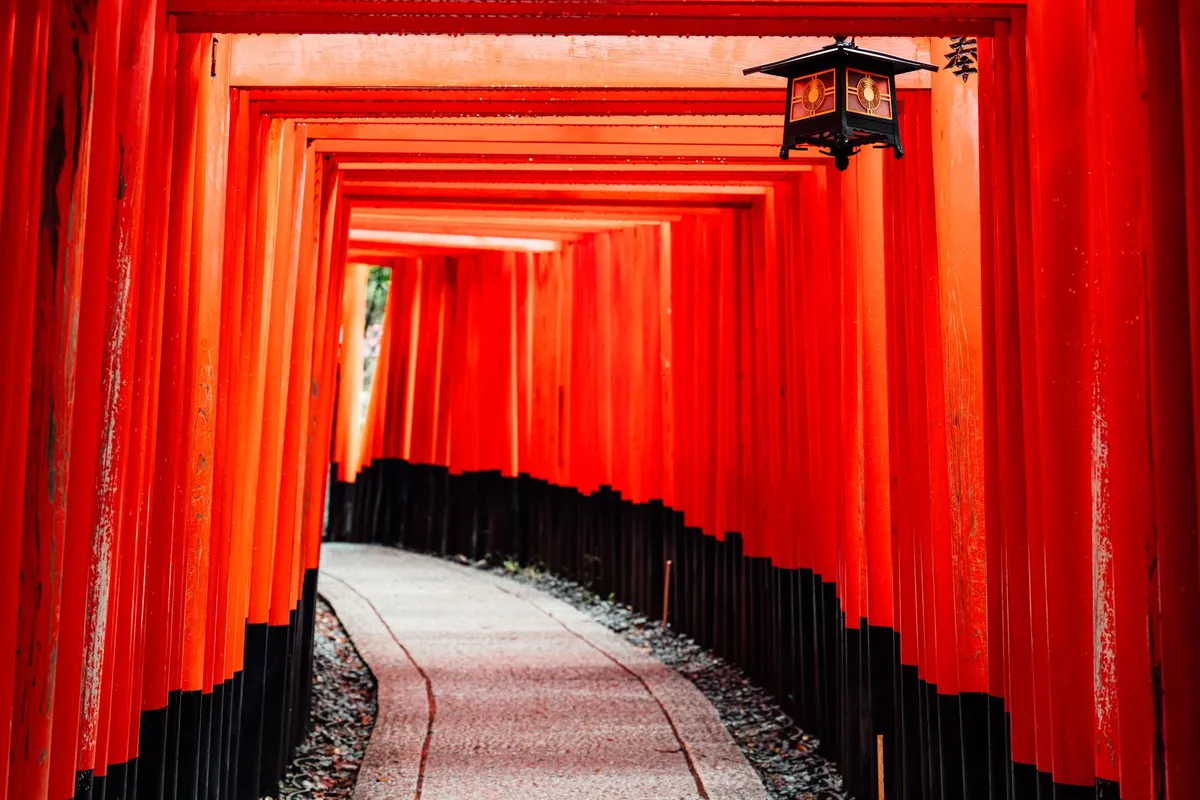
The path of gates climbing the mountain is called Senbon Torii, which literally means “a thousand gates” — though the real number is far higher, as you’ll see in the next section.
How much does it cost to enter Fushimi Inari?
Admission to Fushimi Inari Taisha is completely free, and there’s no ticket booth, turnstile, or online reservation — something rare among Japan’s most-visited attractions. That also means there’s no crowd control: during peak hours (10 a.m. to 4 p.m.), the first stretch of the Senbon Torii gets pretty tight for photos.
The only real cost of the trip is getting there. Round-trip train fare from Kyoto Station comes to around ¥300 (about US$2, Aug 2026) per person — not counting water, a snack, or an omikuji (the written fortunes sold at the shrine for ¥200-300 each).
 Partner · Civitatissee all activities in Kyoto ›
- See ›Free Tour of KyotoRating 9.4 · 185 reviews on Civitatis
- See ›Gion Free Walking TourRating 9.1 · 2,025 reviews on Civitatis
- Best of Kyoto TourRating 9 · 344 reviews on Civitatisfrom€86.95per personSee ›
- Gion Night TourRating 9.4 · 93 reviews on Civitatisfrom€24.59per personSee ›
Civitatis prices on 28/09/2026, from, per person. They may change. Want to compare? Activities in Kyoto on GetYourGuide ›
How do you get to Fushimi Inari from Kyoto Station?
The fastest way is to take the JR Nara Line from Kyoto Station to Inari Station — the ride takes just 5 minutes and costs ¥150 (Aug 2026). The station opens right in front of the shrine’s main gate, so there’s no walking involved. Heads up: only local trains (futsu) stop at Inari — express trains on the same line pass right through, so check the board before you board.
If you’re staying near Gion or Kawaramachi, you might prefer the Keihan Line to Fushimi-Inari Station, just a few minutes’ walk from the shrine — more convenient if you’re already in the historic district and don’t want to backtrack to Kyoto Station.
| Option | Time | Price | Best for |
|---|---|---|---|
| JR Nara Line (Kyoto Station → Inari) | 5 min | ¥150 (Aug 2026) | those leaving from the central station or arriving from Nara/Osaka |
| Keihan Line (→ Fushimi-Inari Station) | varies by origin | check the official site | those already in Gion or Kawaramachi |
Where to stay in Kyoto
| Hotel | Rating | |
|---|---|---|
| Sanco Inn Kyoto Hachijoguchi ShikinoyuKyoto Station / Fushimi · In Higashikujo Kamitonoda-cho, 48-1 | 8,74.049 reviews | See prices |
| Kyoto Century HotelKyoto Station / Fushimi · In Higashi Shiokoji-cho, 680, Shimogyo-ku | 9,02.477 reviews | See prices |
| Kyoto Granbell HotelGion / Higashiyama · In Yamatocho, 27, Higashiyama-ku | 8,93.099 reviews | See prices |
| Hotel Yuraku Kyo-yasakaGion / Higashiyama · In Washiocho, 528, Higashiyama | 9,6552 reviews | See prices |
| ASAI Kyoto ShijoKawaramachi / Karasuma · In Shunzeicho, 444, Shimogyo | 9,03.313 reviews | See prices |
| Hotel Traveltine Kyoto KiyamachiKawaramachi / Karasuma · In Nambacho, 403-1 | 9,32.935 reviews | See prices |
| KOKO HOTEL Residence Kyoto Nijo CastleKawaramachi / Karasuma · In Shimomatsuya-cho, 724, Nakagyo-ku | 9,21.063 reviews | See prices |
Booking.com rating on 30/09/2026
How many torii gates are there and what’s the best time to visit?
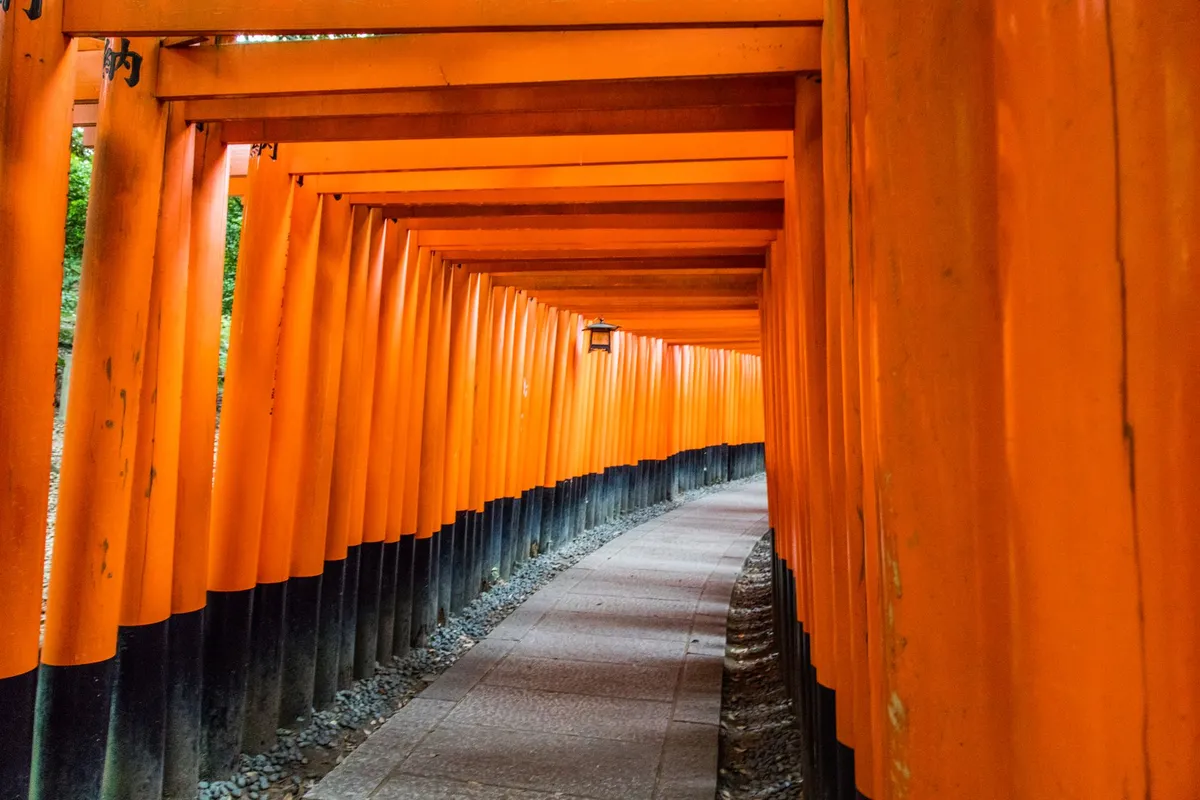
Nobody knows the exact number, but the most-cited estimates range between 8,000 and 10,000 torii along the 4 km of trail to the top of Mount Inari — far more than the “thousand” suggested by the name Senbon Torii. Each gate bears the name of its donor and the date at its base.
The calmest time for crowd-free photos is right after sunrise, before 8 a.m., or at night, when the gates are lit up and the tourist flow drops off sharply. That’s not a hard rule: a local guide can take you along alternative trails during the same peak hours and still dodge the crowds, steering clear of the most-photographed stretch of the Senbon Torii.
Is it worth climbing to the top of Mount Inari?
Yes — mainly because most visitors stop at Yotsutsuji, halfway up, and miss the quietest part of the route, which is exactly where the gates get more spaced out and older, with otsuka memorial stones donated over a thousand years ago. Past Yotsutsuji the crowds thin out considerably, since most tourists turn back right there.
If you’re short on time or feeling tired, going only as far as Yotsutsuji (a 30-45 minute climb) still gets you great photos and a partial view of Kyoto. For those who want the summit, the full round trip covers about 7 km and takes 2 to 3 hours, mostly uphill — closed, non-slip shoes are worth it, because the stone paving gets slippery after rain.
How long does it take to visit the shrine?
To see the main shrine and walk the most photogenic stretch of the Senbon Torii up to Yotsutsuji, allow at least 1 hour. To climb to the summit and back, plan on 2 to 3 hours, with stops to rest and take photos at the small altars along the way. Since the site is open 24 hours, you can fit the visit in before other Kyoto sights on the same day without worrying about closing time.
What nobody tells you before you go
Real total cost of the trip: counting the round-trip train (¥300, Aug 2026) plus water and a snack along the way, you’ll spend around ¥800-1,200 per person (US$5-8, Aug 2026) — far cheaper than most Kyoto attractions.
- GPS fails in the area: near Tofukuji Station, close to Fushimi Inari, the signal tends to drop — download an offline map beforehand.
- It’s not just for agile adults: the full route has stairs and uneven ground; visitors with small children or reduced mobility usually prefer just the stretch up to Yotsutsuji.
- The stone foxes (kitsune) carry objects with meaning: a key, a jewel, a rice sheaf — each one represents something different, and almost nobody explains this on site.
- There’s a little-known bamboo grove around the shrine, a quieter alternative to the famous Arashiyama bamboo forest on the other side of the city.
If you’d rather go with a local guide, you can book a free guided tour of Fushimi Inari — especially useful if you want to understand the meaning of the torii and the foxes without relying on signs in Japanese.
Fushimi Inari is just one stop within a bigger Kyoto itinerary, which also includes the historic Gion district and the Arashiyama Bamboo Grove on the other side of the city.
 HotelAs soon as you have datesCompare neighbourhoods and guest ratings.See hotels ↑
- ActivitiesBefore you travelBook ahead the ones with limited spots.Civitatis ›
 More activitiesTo compareTickets, day trips and tours with flexible cancellation.GetYourGuide ›
Frequently asked questions
Is Fushimi Inari open 24 hours?
Yes, Fushimi Inari Taisha has no closing time and no gate that locks access — you can visit in the middle of the night, though most of the support facilities (shops, staffed restrooms) only operate during the day.
Do you need a ticket or advance reservation?
No. Fushimi Inari doesn’t sell tickets or require reservations; entry is free and open to anyone, at any time.
Can you visit Fushimi Inari at night?
You can, and it’s one of the calmest ways to see the shrine: at night the gates are lit by stone lanterns and the tourist flow drops off considerably compared to business hours. Just be mindful of the dimmer lighting on the forest stretch climbing the mountain.
Is there a bamboo forest near Fushimi Inari?
There’s a bamboo grove around the shrine, but Kyoto’s most famous bamboo forest is the one in Arashiyama, in another part of the city — they’re separate outings, and you can’t combine both on foot in the same trip.
Conclusion
Fushimi Inari works just as well as a quick 1-hour stop or a full morning of hiking between torii — the key is deciding beforehand whether you’ll go only as far as Yotsutsuji or all the way to the top, because the effort involved is very different. For more itineraries and practical tips about the city, Voyage Voyage has other guides to Kyoto and Japan.