The Colosseum in Rome is the largest amphitheater ever built by humankind, and nearly two thousand years after its inauguration, it remains Italy’s most visited monument. Located in the heart of Rome, just steps from the Roman Forum and Palatine Hill, it opens daily at 8:30 AM and can be accessed with a ticket that includes all three sites. From the US, you can reach Rome with a single connection—through Lisbon, Paris, Frankfurt, or Madrid—and the total flight time is around 14 to 17 hours. The best time to visit is from March to May and September to November, when the heat is bearable and the lines are shorter. What you might not know is that the Colosseum almost didn’t exist: it was built exactly where the artificial lake of Emperor Nero’s palace once stood.
How to get to the Colosseum
Rome has two international airports: Fiumicino (FCO), the main one, and Ciampino (CIA), used by low-cost airlines. From the US, most flights arrive at Fiumicino with a single layover. From Fiumicino to Rome’s city center, the Leonardo Express goes directly to Termini Station in 32 minutes, with departures every 30 minutes—a ticket costs €14 (check the current price on the Trenitalia website before you travel). From the airport, a taxi with a fixed fare to the historic center costs around €50.
From Termini Station to the Colosseum, Metro Line B takes you to the Colosseo stop in just 3 minutes—one of the most direct connections in Europe between a historical attraction and public transport. Walking from the stop to the entrance takes less than 2 minutes. A single metro ticket costs €1.50, and a 48-hour or 72-hour pass is usually worth it if you’re planning to explore the city.
If you’re doing a day trip from another Italian city, high-speed trains get you there quickly: from Florence, about 1h30 on the Frecciarossa; from Milan, roughly 3 hours; from Naples, less than 1h15. Rome Termini is 10 minutes from the Colosseum by metro.
Best time to visit and how long to stay
“Can I go in the summer?” You can, but you’ll sweat. July and August are the busiest months of the year—huge lines, 95°F+ heat, and hotel prices through the roof. The best window is April to June and September to October: temperatures between 64°F and 82°F, clear skies, and great light for photos. March is a safe bet for those who want fewer crowds and lower prices—it’s cool, but nothing a jacket can’t fix.
For the Colosseum alone, a well-spent morning is enough: 2 to 3 hours inside the complex, plus 30 minutes for the Arch of Constantine and the external surroundings. But the standard ticket already includes the Roman Forum and Palatine Hill, which together need another 2 to 3 hours. Plan at least a full day to see all three sites at a relaxed pace.
Rome as a city needs at least 4 days to cover the main highlights—the Vatican, Pantheon, Trevi Fountain, Trastevere, Borghese—without rushing. A week allows you to explore the neighborhoods more deeply and take a day trip to Pompeii or Naples.
The history of the Colosseum
The Colosseum was commissioned by Emperor Vespasian, of the Flavian dynasty, in 72 AD. The construction was completed in 80 AD by his son Titus—who inaugurated the amphitheater with 100 days of continuous games, during which, according to accounts from the time, more than 9,000 animals died. The official name is the Flavian Amphitheater; “Colosseum” came later, in the Middle Ages, probably because of the Colossus Neronis—a colossal statue of Emperor Nero about 30 meters tall that stood nearby. The meaning of the name, therefore, is not “collision” or “colossal battle”: it’s simply a reference to the giant statue next door.
The amphitheater was built exactly where Nero had constructed an artificial lake as part of his extravagant private palace, the Domus Aurea. By returning that land to the Roman people with a public entertainment space, Vespasian made a clear political statement: what Nero used for himself, the new dynasty gives back to the city.
With an estimated capacity of 50,000 to 80,000 spectators, the Colosseum had a tiered seating system organized by social class: senators in the front rows, equestrians behind them, plebeians further up, and women and slaves at the top. A system of 80 numbered entrances (called vomitoria) allowed the amphitheater to be emptied in less than 15 minutes—an engineering solution that many modern stadiums still can’t replicate.
The spectacles that took place there were mainly of two types: gladiator combats (munera) and wild animal hunts (venationes). Lions, bears, tigers, leopards, hippos, rhinos, and elephants were brought from all corners of the Empire to the hypogeum—the underground network of corridors and chambers below the arena—and hoisted through trapdoors directly onto the sand. It’s estimated that, over the Colosseum’s nearly 400 years of operation, more than a million wild animals were killed in the venationes.
There were also public executions and reenactments of mythological battles, plus a surprising phenomenon recorded in the Colosseum’s early years: simulated naval battles. Ancient writers report that the amphitheater was flooded to stage naumachiae—battles with real boats and prisoners as crew. Whether this actually happened inside the Colosseum itself (rather than in an adjacent lake) is still debated by archaeologists today, but the tradition persists in Roman history.
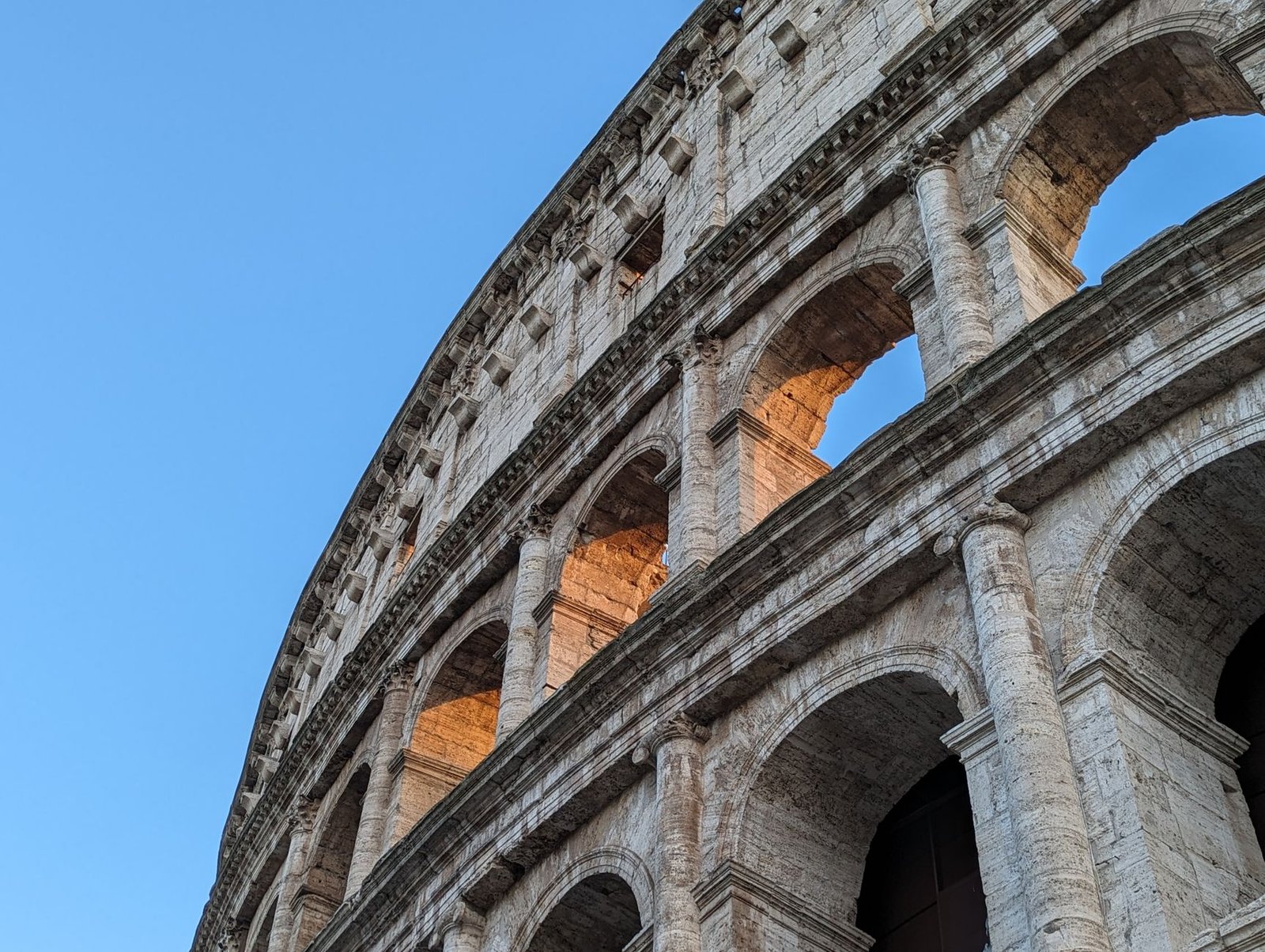
Why does the Colosseum have holes?
If you look at the Colosseum’s outer wall up close, you’ll notice hundreds of regular holes scattered across the stone. They’re not war damage or erosion: they’re scars from the Middle Ages. The Romans used iron and bronze clamps to fit the travertine blocks together—a precise engineering technique that eliminated the need for mortar in the main joints. During the 5th to 15th centuries, when the Colosseum was abandoned as an amphitheater and repurposed as a quarry, medieval residents and builders ripped out these clamps to melt down the metal and reuse it. It’s estimated that over 100 tons of metal were extracted from the Colosseum this way—the equivalent of stripping the internal structure of a modern 10-story building.
What does the Colosseum have to do with Jesus and Christians?
This is the question that most divides historians and the faithful. The belief that Christians were martyred at the Colosseum became entrenched in Catholic tradition over the centuries, but direct historical evidence is scarce and controversial. In 1675, Pope Clement X declared the Colosseum a sacred site in memory of Christian martyrs, and since then a large wooden cross has stood inside the amphitheater. Every year on Good Friday, the Pope leads the Stations of the Cross through the ruins—one of the most iconic images of the Roman liturgical calendar. Most historians accept that Christians were executed in Roman arenas by the Empire; the debate is whether this happened specifically inside the Colosseum or in other venues across the city. What no one disputes is that the monument has become, over the centuries, a symbol of Christian suffering at the hands of Rome.
The emperor who fought in the arena
Which Roman emperor fought in the Colosseum? The answer is Commodus—son of Marcus Aurelius, who ruled from 180 to 192 AD. Unlike any predecessor, Commodus wasn’t content to just watch the games: he himself descended into the arena, dressed as a gladiator, and fought against opponents carefully selected to always lose. He identified with Hercules and even had coins minted with his face on the body of the mythical hero. Commodus didn’t die in the Colosseum—he was assassinated in his palace, strangled by a wrestler hired by the very courtiers conspiring against him. But his time in the amphitheater is etched in history as one of the most eccentric episodes of Imperial Rome.
What to see and do at the Colosseum
The standard ticket at €25 (2026 pricing—confirm on the official site before you travel) includes the Colosseum, the Roman Forum, and Palatine Hill, and is valid for 24 hours—but entry to the Colosseum is a one-time visit at your scheduled time. There’s also the Arena Experience ticket (from €74), which grants access to the arena floor where gladiators once fought, and the Full Experience ticket (from €95), which also includes the underground tunnels of the hypogeum. Book online at the official Colosseum website—morning time slots sell out weeks in advance during high season (April through October). Visitors under 18 get in free; EU students aged 18–24 pay €2.
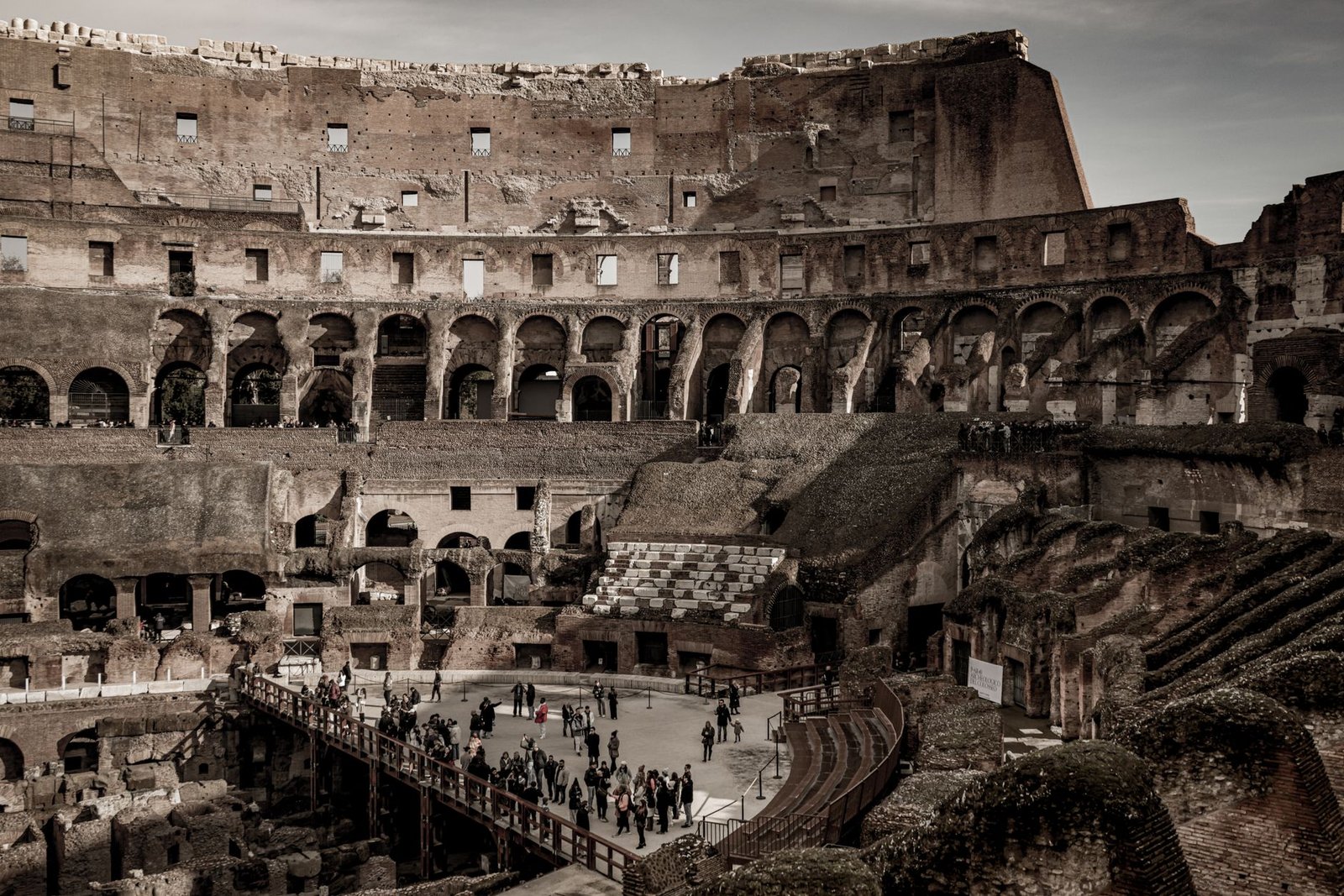
Inside the Colosseum, the first two levels showcase the original seating structure, the numbered access ramps, and informational panels explaining how the games worked. From the second level, you get one of the best views of the amphitheater from within—it’s the spot where you truly grasp the sheer scale of the place. The hypogeum, accessible with the upgraded ticket, is an experience all its own: a labyrinthine network of dark tunnels from which gladiators and animals were hoisted into the arena by wooden winches.
The Arch of Constantine sits right at the exit and is one of the best-preserved triumphal arches from the Roman world—worth the 5-minute detour before you head on to the Forum.
What to pair it with and the surrounding area
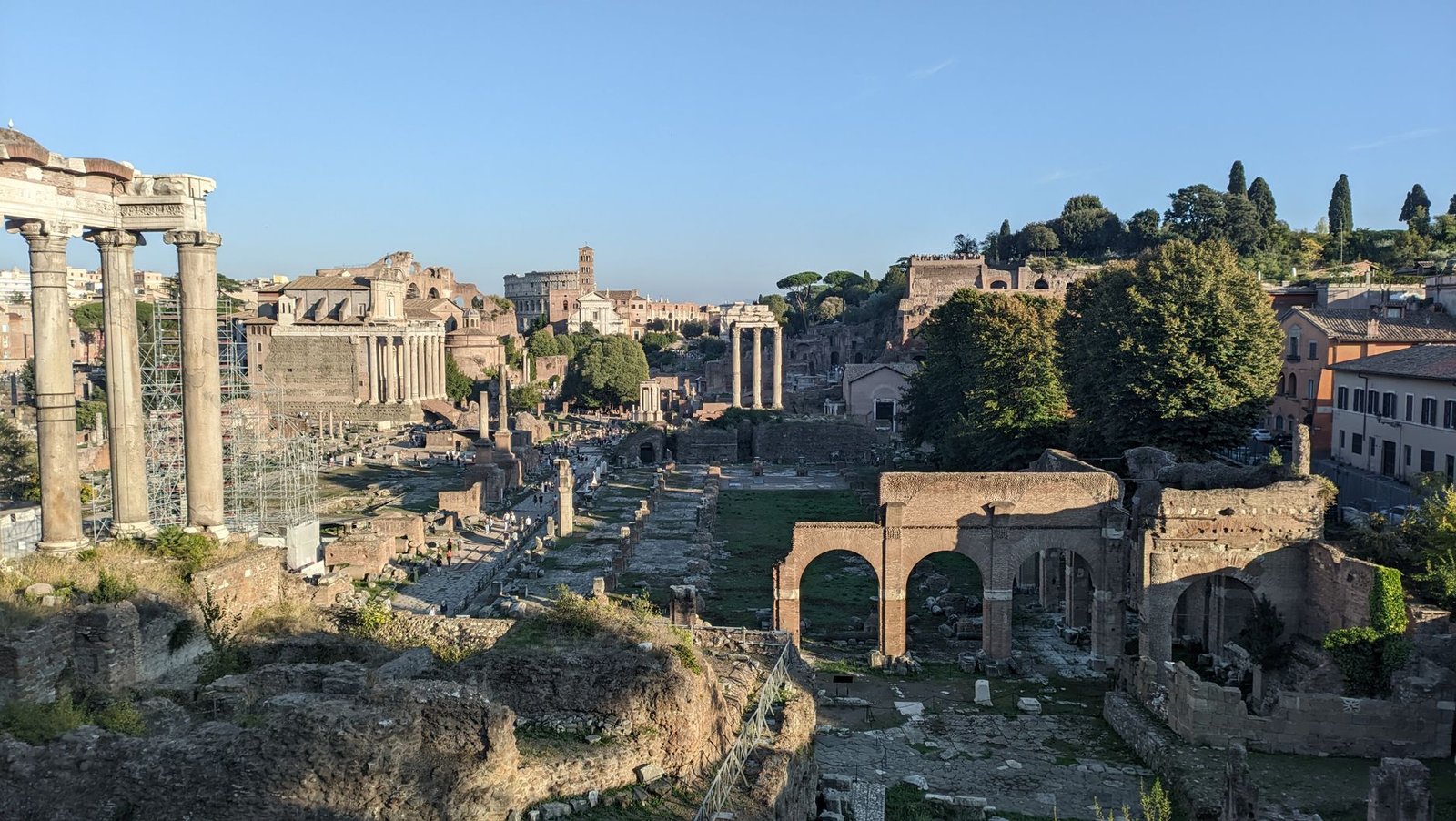
The Roman Forum and Palatine Hill are included in the same ticket as the Colosseum—you enter through the side gates at no extra cost. The Forum was Rome’s political, religious, and commercial heart for centuries: here you’ll find the remains of the Temple of Venus and Roma, the Temple of Saturn, the Via Sacra, and the Arch of Titus. Palatine Hill, where legend says Romulus founded Rome, holds mosaics and gardens with a privileged view over the Forum below. Set aside at least 2 hours to explore both at a relaxed pace.
The Domus Aurea, the palace Nero built on the site where the Colosseum now stands, can be visited separately with its own ticket and guided tour. Only a fraction of the palace survived, but the frescoes and architecture of what remains are extraordinary. Tickets sell out fast—book weeks in advance.
If you want to explore Rome beyond the Colosseum, you’ll find a complete guide with neighborhoods, restaurants, and itineraries in our article on Rome: The Complete Guide to Planning Your Trip—from where to stay to how to get around the city without wasting time.
Where to eat in Rome
Rome isn’t a food destination? Anyone who says that has never had a properly made cacio e pepe. Roman cuisine is simple, abundant, and deeply satisfying: pasta with pecorino cheese and black pepper, pasta all’amatriciana with guanciale and tomato, and the supplì—a fried rice ball stuffed with tomato sauce and cheese, sold at bakeries and fry shops for €1 or €2.
Near the Colosseum, the restaurants on Via Sacra and in the immediate surroundings are mostly tourist traps with inflated prices. Walk 10 minutes toward the Testaccio neighborhood—historically Rome’s working-class district—to eat better and cheaper. A full meal at a neighborhood trattoria runs €15 to €25 per person, without the tourist markup charged at tables with a view of the ruins.
Gelato is a must, but learn to tell the difference: gelato shops with covered tubs and muted colors signal an artisanal product. Open tubs with gelato piled into colorful mountains usually mean an industrial product. A scoop at a good place costs €2 to €3.
Where to stay in Rome
The most central neighborhoods if you want the Colosseum at your doorstep are Celio or Esquilino, both a 10- to 15-minute walk from the amphitheater. Esquilino has hotels at every price point, sits near Termini station, and is practical for those arriving by train or planning day trips to other cities.
For those who prefer to be in the historic heart of the city, the Centro Storico (the Navona, Campo de’ Fiori, and Pantheon neighborhoods) offers the most immersive experience—you step out of your hotel and you’re just blocks from fountains, baroque churches, and historic cafés. The downside is the price: hotels here are significantly more expensive.
The Trastevere neighborhood is the most charming option for those wanting local atmosphere: cobblestone streets, trattorias with sidewalk tables, and a laid-back nightlife. It’s a 20- to 30-minute walk from the Colosseum, but has excellent bus connections.
Practical tips
Lines and timing: arrive at opening time (8:30 AM) or buy your ticket online with a scheduled entry time. Without an online reservation during high season, the line can stretch past 2 hours. The busiest slots are from 10 AM to 2 PM—early morning and late afternoon are noticeably calmer.
Currency: Italy uses the euro (€). Cards are accepted just about everywhere, but bring some cash for markets, bakeries, and small establishments.
Visas: Brazilians can enter Italy (and the entire Schengen Zone) without a visa for stays of up to 90 days within any 180-day period. Starting in 2026, the ETIAS system is expected to roll out—an online paid electronic authorization, similar to the US ESTA. Check the current requirements on the Italian consulate’s website or the European Union portal before you travel, as rules can change.
Why the Colosseum became a ruin: the decline began with the great earthquakes of the 4th and 5th centuries, which toppled part of the southern structure. Then, with the fall of the Western Roman Empire in 476 AD, the Colosseum lost its purpose and was progressively emptied. During the Middle Ages, powerful Roman families—like the Frangipane—occupied the amphitheater as a fortress. From the 12th century onward, the Colosseum became an official quarry: blocks of travertine, marble, and brick were stripped away to build churches, palaces, and bridges across the city. It’s estimated that two-thirds of the Colosseum’s original material was repurposed in other Roman constructions. Only in the 19th century did the monument receive systematic protection and begin to be studied and restored.
Safety and precautions: the area around the Colosseum is full of guide vendors and people dressed as Roman centurions who charge for photo services—usually at prices well above what’s advertised. Ignore approaches while in line. The metro at the Colosseo station is a high-traffic tourist area, so keep an eye on your pockets and bags.
Frequently asked questions
What does the name “Colosseum” mean?
The name “Colosseum” doesn’t come from “colossal” or “collision.” It comes from the Colossus Neronis—a giant statue about 30 meters tall depicting Emperor Nero that stood beside the amphitheater. The monument’s official name is the Flavian Amphitheater, in honor of the dynasty that built it. The nickname “Colosseum” emerged in the Middle Ages and stuck.
Were there lions, bears, and other animals in the Colosseum?
Yes. The venationes (animal hunts) were among the most popular spectacles at the Colosseum. Lions, bears, tigers, leopards, hippos, rhinos, elephants, and giraffes came from the Empire’s African and Asian provinces. The animals were housed in the hypogeum—the network of underground tunnels—and hoisted through trapdoors directly into the arena. Estimates suggest that over a million animals were killed during the centuries the amphitheater was in operation.
Were there naval battles with water in the Colosseum?
Ancient writers recorded that the Colosseum was flooded in its early years to stage mock naval battles, the naumachiae. The inauguration by Titus in 80 AD supposedly included this type of spectacle. However, whether these battles took place inside the amphitheater itself or in a nearby artificial lake is still debated by archaeologists today — the structure of the hypogeum installed later would have made flooding very difficult. What is certain is that Rome staged naumachiae in other locations around the city.
What does the Colosseum have to do with Jesus and Christians?
Christian tradition associates the Colosseum with the martyrdom of believers persecuted by the Roman Empire. In 1675, Pope Clement X declared the site sacred in memory of the martyrs. Today, a large wooden cross stands inside the amphitheater, and the Pope leads the Via Crucis there every Good Friday. Direct historical evidence that Christians were specifically martyred at the Colosseum is disputed, but most historians accept that executions of Christians took place in Roman arenas — the debate is over which ones exactly.
Why does the Colosseum have so many holes in the stone?
The holes are marks left by metal clamps — iron and bronze — that the Romans used to bind the travertine stone blocks together with precision. In the Middle Ages, the Colosseum was used as a quarry, and medieval builders ripped out these clamps to melt down and reuse the metal in new construction. It’s estimated that over 100 tons of metal were removed this way. The result is the regular holes that still mark the entire facade and inner walls today.
Conclusion
The Colosseum isn’t just a symbol of Rome — it’s a mirror of how power, spectacle, and engineering intertwined in the greatest empire of the ancient world. Getting there early in the morning, before the crowds, and standing still at the edge of the arena gazing down at the hypogeum as the sun filters through the arches is an experience like no other. Book your ticket in advance, include the Roman Forum on the same day, and leave time to wander the city without rushing.
Explore the other destination guides here on Voyage Voyage and plan your next adventure with more confidence.