 Marcelo Oliveira
Alicante is a mid-sized Mediterranean city in southeastern Spain that works well for anyone who wants beach and city life at the same address — without the scale of Barcelona or Madrid. For a short trip, it’s easy to fit in; for staying weeks or considering a longer stint, the deciding factor is something else: this is a provincial capital of around 366,000 residents, with a university, services, and a seafront that’s part of everyday routine, not just the tourist itinerary.
Hotels in Alicantefree cancellation options onlySee hotels ›Booking.com partner (advertising): we may earn a commission at no extra cost to you.
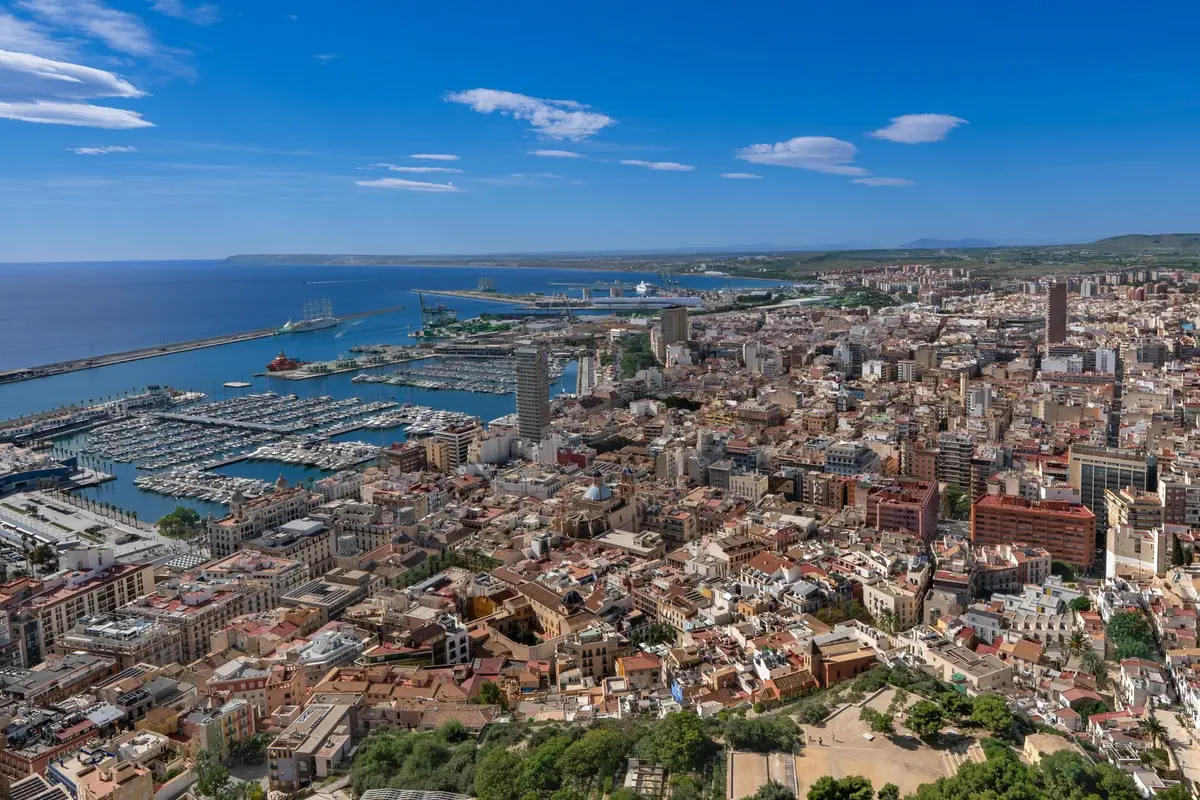
Alicante or Alacant: what changes with the name?
In Spanish, the city is called Alicante. You’ll also see Alacant, the Valencian form. That’s why on signs, at the train station, and on official websites, you’ll often see “Alicante/Alacant.” These aren’t two cities or a tourist translation: they’re the two official names used for the same place.
For searching accommodations, tickets, or maps, both terms work. In practice, “Alicante” dominates conversations in Castilian Spanish and in search engines, while “Alacant” signals the presence of the Valencian language in the Valencian Community.
What language is spoken in Alicante and in Spain?
In Alicante, you can communicate in Castilian — the language we usually call Spanish — without any trouble. It’s the official language of all of Spain. In the Valencian Community, Valencian is also co-official; that’s why it appears on signage, street names, schools, and public communications. The very name Alicante/Alacant is the most visible example.
There’s no useful answer that reduces “what language do they speak in Spain?” to a single tongue. Castilian is national, but the Spanish Constitution allows other languages to be official in the autonomous communities. Besides Valencian, there’s Catalan, Galician, Basque, and Aranese in their respective territories and legal contexts. For visitors, the practical rule is simple: speak Castilian; in Alicante, recognizing a few words in Valencian helps you read signs, but it’s not a requirement for traveling.
If you’re thinking about living there, it’s worth treating this as part of the cultural adjustment rather than an obstacle. “Bon dia,” for example, is “good morning” in Valencian; “ajuntament” is city hall. The city is bilingual in part of its public life, but the essential information for daily life is also available in Castilian.
What is life in Alicante like?
The short answer: Alicante tends to please anyone looking for a coastal city with the infrastructure of a regional capital, but without needing a metropolis. The municipality recorded 366,221 residents in the official revision of the padrón as of January 1, 2025. That size translates into residential neighborhoods, shops, services, cultural activities, and university life, without the center ceasing to be walkable for most trips.
The sea carries real weight in the urban experience. Postiguet Beach sits right next to the center, and the waterfront, the marina, and the old town connect in a single area. That doesn’t mean the whole city runs on vacation time: there’s public administration, a university, and the Distrito Digital, an initiative tied to the tech economy. The fairest read is of a city that blends local routine, students, work, and seasonal tourism.
For a long stay, choose your neighborhood based on the routine you want. Near the center, the station, and the old town, you gain walkable access to restaurants, services, and transport, but there’s also more bustle. Areas near Playa de San Juan prioritize the beach connection and have a more residential feel. Before signing a lease, check the map for distance to the nearest market, tram or bus stop, and how long the trip back at night takes; “near the sea” alone doesn’t tell you what daily life will be like.
It’s also worth calibrating expectations. Alicante is better for those who want to alternate between a relaxed urban schedule and the Mediterranean than for those seeking the nearly endless offerings of a major capital. If your priority is large-scale museums, wildly different neighborhoods, and packed programming every day, Barcelona delivers more variety. If your priority is simplifying your routine while still having a city around you, Alicante offers a convincing balance.
Distance between Barcelona and Alicante: how to plan the trip
The Alicante City Council lists 544 km between Barcelona and Alicante. That’s a significant distance for planning your itinerary: don’t treat the two cities as a day trip. By car, expect a long journey with traffic variables; by train, the Renfe connection departs from Barcelona Sants and arrives at Alicante/Alacant Terminal, with both stations in central areas.
The Euromed is the direct rail option offered by Renfe. Schedules, duration, and price change depending on the day and how far in advance you book, so the right move is to check your actual travel date on the operator’s website before reserving. If you’re combining both destinations, a good split is to use Barcelona for the more intense urban portion and Alicante to slow down at the end of the trip — instead of trying to cram everything into a few days.
Alicante/Alacant Terminal station has connections to buses, taxis, and Cercanías, which helps on arrival. Even so, check your accommodation’s address: getting to the station doesn’t automatically solve the last leg to an apartment in a beach neighborhood or a less central area.
How many days to set aside and how to fit Alicante into your itinerary
To feel the city beyond the beach photo, plan at least three nights. With two, you can get a first read on the center and the waterfront, but you’ll have little room to choose your own pace or explore a more distant beach. Four or five nights make more sense when the trip includes rest, remote work, or a visit with short trips around the region.
The best plan depends on your goal. If you’re coming from Barcelona, you can arrive, sleep near the center, and use the first full day to get oriented on foot. On the second, choose between beach, historic neighborhood, and a booked activity. On the third, decide whether you want to go deeper into Alicante or move on. This order avoids the common mistake of building a Barcelona schedule in a city that invites you to leave hours free.
For a long stay, don’t choose your address based on scenery alone. Try to understand whether you plan to rely on public transport, whether you’ll work from the apartment, and whether you’d rather wake up in the center or in a more residential area by the sea. Alicante can be easy to live in precisely because it concentrates a lot in a manageable scale; the trade-off is that not all neighborhoods offer the same connections or the same atmosphere outside of summer.
Is Alicante worth visiting?
Yes, especially if you’re looking for a Mediterranean Spain that’s easier to live in than to just check off on a map. Alicante is a good choice for three types of travelers: those who want a few beach days with a real city around them; those planning a longer stay without giving up services; and those building a route between Barcelona, Valencia, and the south of the country.
It can disappoint if your expectation is Barcelona’s continuous energy or if you want to fill every hour with giant attractions. In that case, use Alicante as part of a bigger trip or keep your focus on its concrete highlights. To organize that side of your itinerary, also read Alicante beyond the beach: a free castle and rice worth the detour.
For first-time visitors, a guided walk can shorten the adjustment curve: you get a feel for the layout of the center, the local names, and which areas deserve a return visit at a slower pace.
 Partner · Civitatissee all activities in Alicante ›
Round-Trip Tabarca Island Ferry from Alicante
Rating 8.3 · 1,000 reviews on Civitatis
- Cabo de las Huertas Stargazing Tourfrom€40per personSee ›
- Santa Bárbara Castle Beer Tasting TourRating 8.9 · 156 reviews on Civitatisfrom€18per personSee ›
- See ›Santa Bárbara Castle Free TourRating 9 · 1,081 reviews on Civitatis
- See ›Alicante Free Walking TourRating 9 · 6,565 reviews on Civitatis
Civitatis prices on 28/09/2026, from, per person. They may change. Want to compare? Activities in Alicante on GetYourGuide ›
Quick questions about Alicante and Spain’s languages
How many languages are there in Spain?
There’s no single simple number, because it depends on whether you count only official languages, recognized regional languages, or linguistic varieties. For traveling, keep the essentials: Castilian is official nationwide; in some communities, other languages are also co-official. In Alicante, those are Castilian and Valencian.
On forms and services, the naming may appear duplicated. That’s normal: read “Alicante/Alacant” as a single city and just check the neighborhood, the address, and the language of the instructions.
Do I need to speak Valencian to travel to Alicante?
No. Castilian is enough to visit, get around, eat, and handle practical matters. Valencian appears in public spaces, and knowing a few terms makes the experience clearer and more respectful.
Is Alicante a big city?
It’s a big city on a regional scale, not a metropolis. With 366,221 residents in 2025, it has the infrastructure of a provincial capital and its own urban rhythm, but it’s considerably more compact than Barcelona.
Sources consulted
- Ayuntamiento de Alicante — city data, distance, and urban structure
- Ayuntamiento de Alicante — official population figures (2025)
- La Moncloa — Constitution and official languages
- Renfe — Barcelona–Alicante route
 HotelAs soon as you have datesCompare neighbourhoods and guest ratings.Booking ›
- ActivitiesBefore you travelBook ahead the ones with limited spots.Civitatis ›
 More activitiesTo compareTickets, day trips and tours with flexible cancellation.GetYourGuide ›