To explore the ruins of Ephesus in Turkey without rushing, set aside 2 to 3 hours at the archaeological site and use Selçuk as your local base. Entering through the upper gate and exiting through the lower one cuts down on uphill walking, while the Terrace Houses add roughly 30 to 60 minutes. Add the museum, the Basilica of St. John, or the House of the Virgin Mary, and the trip stops being a half-day and fills an entire day.
Why Ephesus deserves your time
Ephesus preserves the logic of a great port city of the Roman world: monumental streets, a theater, a library, commercial areas, temples, and residences all appear along the same route. Unesco highlights precisely this urban continuity, along with the site’s importance to the religious traditions of Anatolia and to the spread of Christianity.
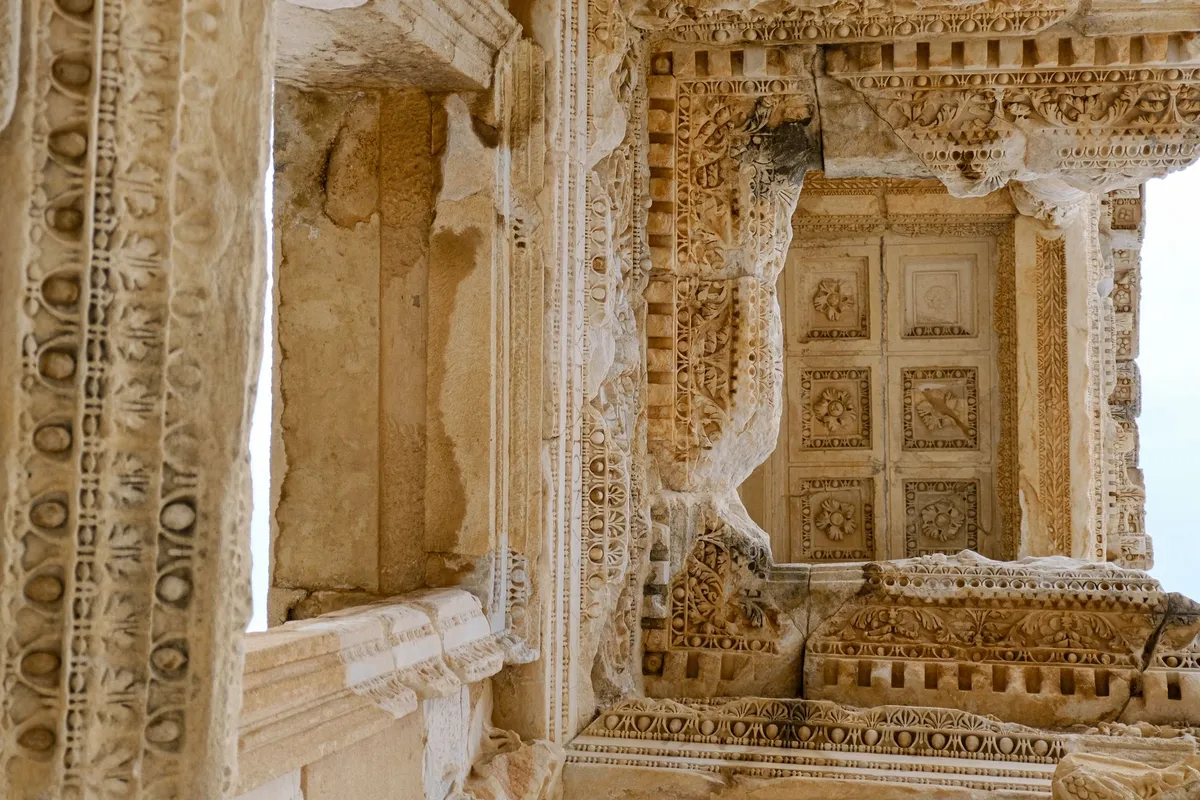
The Library of Celsus is the visual landmark, but it only truly makes sense once you arrive there after walking down Curetes Street. The descent reveals how public buildings, fountains, houses, and circulation spaces all connected. It’s this chain of spaces, not a single facade, that sets Ephesus apart from a mere collection of isolated ruins.
How much time to set aside
Plan on 2 hours for the essential route and 3 hours if you want to include the Terrace Houses and read the panels without rushing. The continuous walk between the gates can be done faster, but that means skipping pauses at the Library of Celsus, the Theater, and the details along Curetes Street.
The math changes with heat, crowds, and your interest in archaeology. A guide to Ephesus visit durations recommends two hours as a minimum and three with the Terrace Houses. Travelers with reduced mobility should add extra margin: the ancient paving is uneven, there are slopes, and the residential complex uses stairs and walkways.
A full day lets you visit the site in the morning, have lunch in Selçuk, and pick two add-ons. Trying to combine Ephesus, the House of the Virgin Mary, the museum, the Basilica of St. John, Şirince, and the beach in a single day sacrifices exactly the time that makes the ruins understandable.
How to get there from Selçuk or Izmir
Selçuk is the most practical base: it sits right next to the archaeological complex, has a train station and a bus terminal, and concentrates the museum, the Basilica of St. John, and the Temple of Artemis. Izmir serves as the air gateway and major regional hub; from there, train or road transport takes you to Selçuk, where the final leg can be done by taxi or local minibus. The official map of Selçuk and Ephesus helps you locate the station, the site, and nearby attractions before you arrive.
If you stay in Selçuk, you can arrive at opening time and build your day without depending on the traffic of a long tour. Kuşadası is convenient for cruise passengers and for those who prefer the coast, but ship schedules concentrate groups in the mid-morning. If you’re driving, arrange your final pickup point in advance if you plan to enter through one gate and exit through the other.
Ephesus fits naturally into a coastal circuit with Bodrum and the Turkish Riviera. To continue south, the Antalya itinerary adds sea and a historic center. Cappadocia in three days requires a separate connection and shouldn’t be treated as a neighbor.
Which gate to use and what order to walk in
To reduce effort, start at the upper gate and walk down to the lower one, following a mostly downhill route. This order takes you past the Odeon and the administrative area before reaching Curetes Street, the Terrace Houses, the Library of Celsus, the Agora, and the Great Theater. The detailed sequence of monuments confirms that the main axis works as a continuous narrative, not as a series of separate stops.
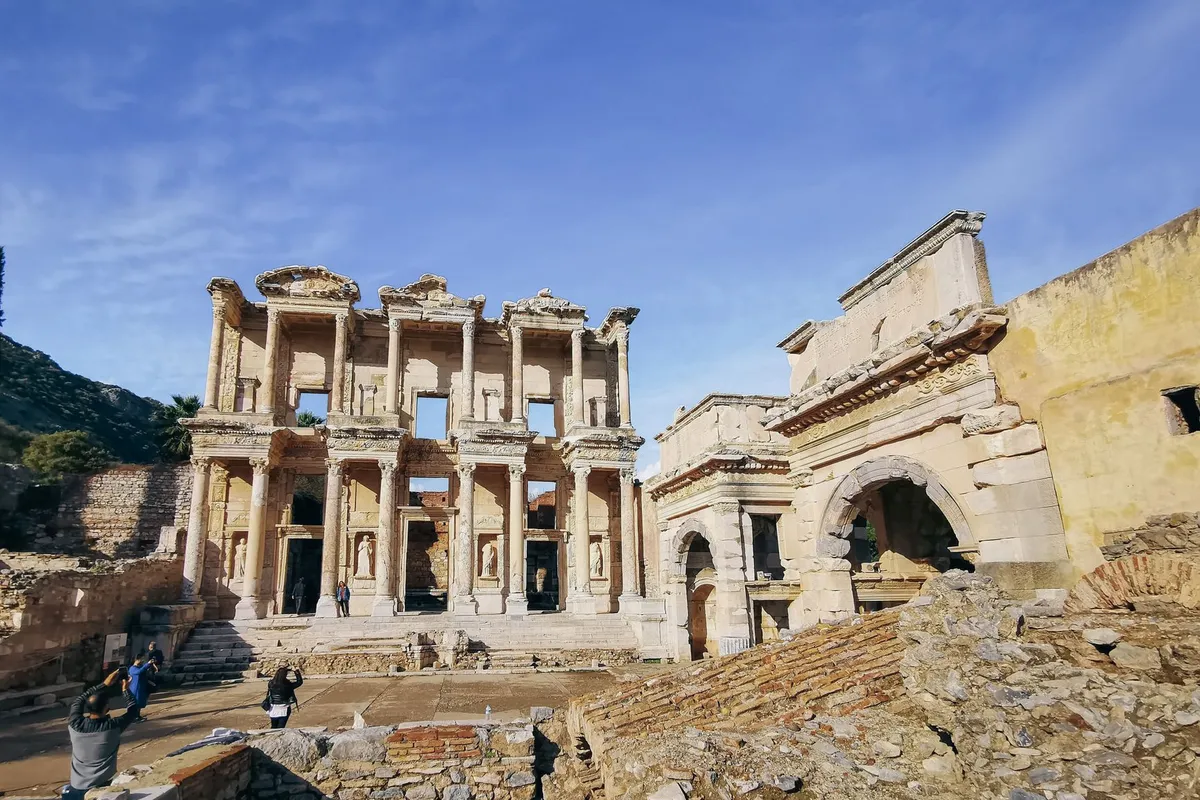
From the Odeon to Curetes Street
The first buildings explain how the city was administered. After the Gate of Hercules, Curetes Street concentrates fountains, a temple, baths, and vistas that lead down to the library. Walk slowly: polished marble, uneven ground, and steps demand attention, especially after rain.
From the Library to the Theater
After the Library of Celsus, cross the commercial area and follow Marble Street to the Great Theater. The axis points toward the ancient harbor, now far from the sea due to sedimentation. This shift in the coastline is central to understanding the history of Ephesus as a port city.
What not to miss in Ephesus
The Library of Celsus, Curetes Street, and the Great Theater are the three priorities on a first visit; the Odeon, the Temple of Hadrian, and the Agora complete your reading of the city. Choosing wisely keeps you from spending all your energy on the first monuments and arriving rushed at the lower half.
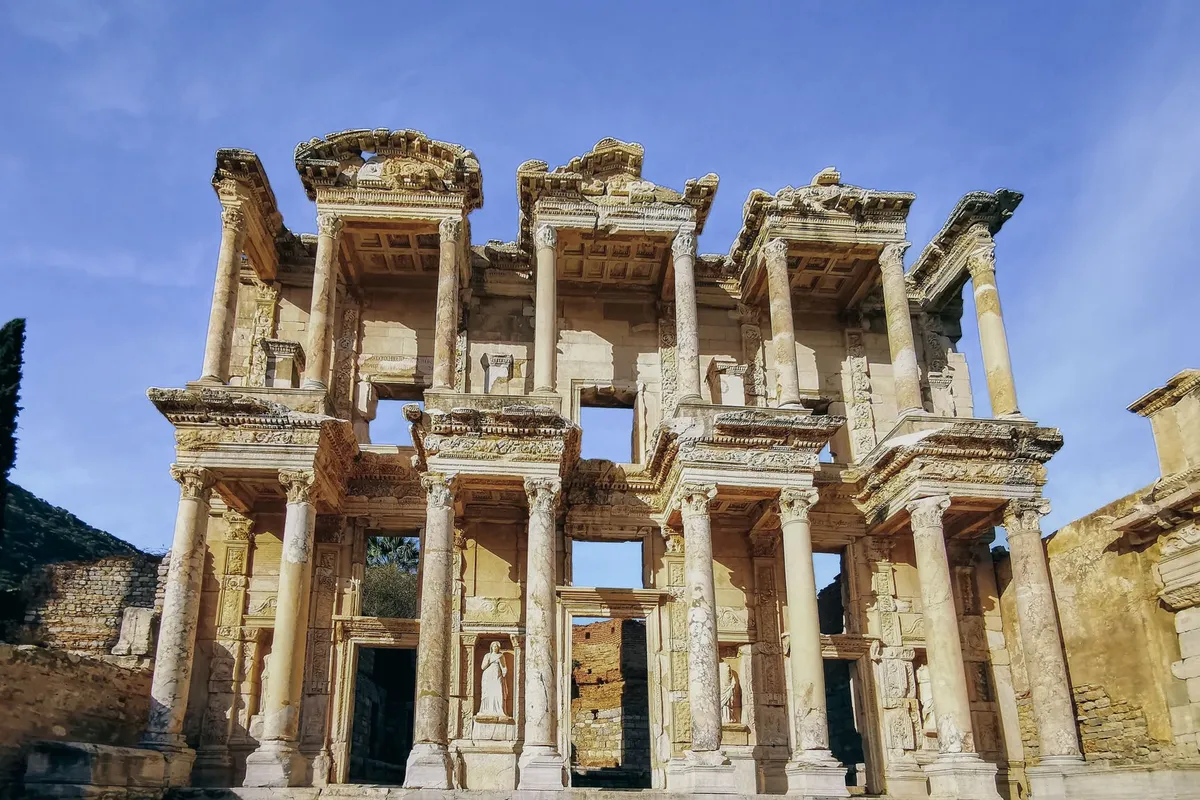
At the library, notice the reconstructed facade and its relationship to the square. On Curetes Street, look for inscriptions, columns, and traces of successive uses. The theater impresses with its scale and also its position: it connected performances, public life, and the road to the harbor.
Are the Terrace Houses worth the extra ticket?
The Terrace Houses are worth the additional ticket for anyone who wants to see the domestic life of the Roman elite, with mosaics, frescoes, courtyards, and water systems; set aside 30 to 60 minutes. They contrast with the grand public spaces and give the site a human scale.
Access involves stairs and walkways under a protective roof. For travelers short on time or with mobility challenges, it may be better to focus your energy on the main route. Since prices and ticket combinations change, confirm your option on the official Turkish museums portal before buying.
When to Go and How to Beat the Crowds
Spring and fall tend to offer more comfortable walking; in summer, head in right at opening or come at the end of the permitted hours. Cruise groups usually cluster between mid-morning and early afternoon, though the pattern shifts depending on when ships dock in Kuşadası.
Bring water, a hat, and shoes with good grip. There’s little shade along most of the route, and the marble reflects the heat. Evening or extended hours pop up in some seasons, but don’t count on them: check the official calendar the week of your visit.
What to Pair with Selçuk
After Ephesus, choose between the Ephesus Museum, the Basilica of St. John, and the Temple of Artemis; two of these are plenty for a well-balanced day. The museum gathers sculptures and finds that suddenly make sense right after your walk. The basilica adds the Christian layer of Ayasuluk, while the temple demands realistic expectations: only a few visible elements remain of an ancient wonder.
The House of the Virgin Mary sits up in the hills and requires transport, so plan it in advance. Şirince asks for even more time and shifts the focus to village life, scenery, and food. If archaeology is your main interest, stay in Selçuk; if you want a change of pace at the end of the day, the extension to the village can work well.
Traveling with kids? You can turn the route into four concrete stories: the gathering at the Odeon, the water of the fountains, the books of the library, and the audience at the theater. This framing cuts down on the fatigue caused by a parade of dates and keeps attention on how the spaces actually worked. For photography, it’s worth alternating wide shots with inscriptions and textures, always without climbing on structures or crossing barriers.
Before you head out, confirm your ticket, hours, and transport point. The best visit to Ephesus isn’t the one that racks up the most stops, but the one that saves two or three hours to walk the ancient city in sequence and still leaves you energy for a coherent add-on.