 Marcelo Oliveira
The Círio de Nazaré 2026 takes place on October 11, in Belém do Pará, drawing more than two million people to what is the largest Catholic procession in Brazil and one of the biggest in the world. This tradition, more than 230 years old, turns the capital of Pará into a stage of faith, food, and Amazonian culture throughout the entire month of October — and it keeps attracting more and more tourists who aren’t necessarily religious.
Hotels in Belémfree cancellation options onlySee hotels ›Booking.com partner (advertising): we may earn a commission at no extra cost to you.
The Círio de Nazaré 2026 falls on Sunday, October 11, with the main procession departing from the Catedral da Sé at 7 a.m. and covering 3.6 km to the Basílica Santuário de Nazaré. Watching from the sidewalks is free; grandstand seats cost from R$ 40 to R$ 100 (Sept 2026). Book your hotel months in advance — Belém fills up.
| Date (2026) | Sunday, October 11 (main procession). Festivities from October 6 to 26. |
|---|---|
| Time | Mass at 6 a.m. at the Catedral da Sé; procession departs at 7 a.m. |
| Route | Catedral da Sé → Basílica Santuário de Nazaré (3.6 km) |
| Free? | Yes, on the sidewalks and walking alongside the berlinda. Grandstands: R$ 40–100 (Sept 2026) |
| How to get there | Fly to Belém International Airport (BEL), 12 km from downtown |
| Estimated crowd | More than 2 million people at the main procession |
What is the Círio de Nazaré and why is it worth the trip?
The Círio de Nazaré is the largest religious event in Brazil: a procession honoring Our Lady of Nazareth that takes place every second Sunday of October in Belém do Pará since 1793. It has been recognized as Intangible Cultural Heritage of Brazil by IPHAN since 2004 and was inscribed on UNESCO’s representative list in 2013.
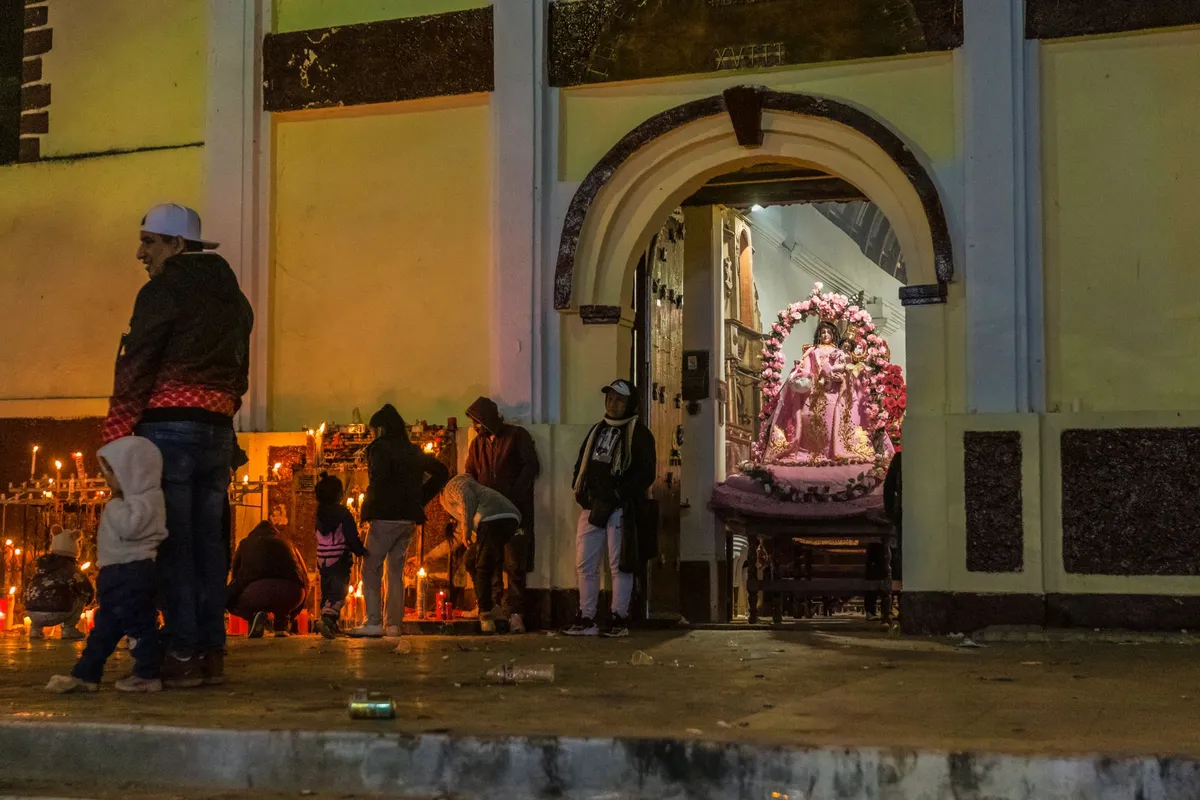
The main procession brings together more than two million people across 3.6 km of packed streets — to give you an idea, that’s more people than Salvador’s Carnival in a single day. But the Círio goes far beyond the procession: it’s three weeks of pilgrimages, novenas, a food fair, and the famous Círio lunch, when Pará families open their doors to serve maniçoba and pato no tucupi. Even non-Catholics are blown away by the energy of the city.
For anyone who’s never been to the North, the Círio works as a gateway to Belém and Amazonian culture — and you can even combine the trip with the Belém itinerary featuring Ver-o-Peso and its food scene.
When does the Círio de Nazaré 2026 take place?
The main procession of the Círio de Nazaré 2026 will be on Sunday, October 11, 2026. The full festivities run from October 6 to 26, with 14 pilgrimages and religious events over three weeks.
The actual Círio week begins on the Wednesday before Sunday, with the transfer of the promise cars. The two most intense moments for tourists are the Trasladação, on Saturday night, October 10 (the 3.6 km nighttime candlelit procession), and the Círio on Sunday morning.
In 2026, the post-Círio pilgrimages had their dates adjusted compared to previous years: the Runners’ Pilgrimage, the Accessibility Pilgrimage, and the Youth Pilgrimage were all concentrated on Saturday, October 17, while the Cycling Pilgrimage and the Feast Procession take place on Saturday, October 24 (Círio Board of Directors, Sept 2026). The Recírio, which closes the festivities, will be on October 26.
What is the procession route and how long does it last?
The Círio procession covers 3.6 km from the Catedral Metropolitana de Belém to Praça Santuário de Nazaré, in the Nazaré neighborhood. The route passes through some of the most traditional streets of the historic center and usually takes between 4 and 5 hours — the berlinda (the float carrying the image of Our Lady) moves slowly, surrounded by the crowd and by devotees pulling the rope.

But Sunday is just the climax. Before that, the image of Our Lady travels nearly 100 km in two days: on Friday, the Traslado to Ananindeua covers 47 km in about 12 hours. On Saturday, the Road Pilgrimage goes 24 km back to Icoaraci, where the image boards for the River Pilgrimage, an 18 km journey across Guajará Bay — a boat procession that’s a spectacle in its own right. Then comes the Motorcycle Pilgrimage (2.6 km) and, at night, the Trasladação.
For first-time visitors, the two unmissable moments are the Trasladação (Saturday night, more intimate, lit by candles) and the Círio (Sunday morning, the peak with the full crowd). If you only have one day, choose Sunday — but try to arrive on Saturday to experience the Trasladação.
How to take part in the Círio — the rope, the berlinda, and promises
Anyone can take part in the Círio de Nazaré, regardless of religion. The most common way is simply to follow the procession from the sidewalks or walk alongside the parade in the street. But there are specific ways to participate that are part of the tradition:
The Círio rope is the best-known symbol: a sisal rope about 400 meters long that connects the berlinda to the devotees who pull it. Holding the rope is an act of faith and physical effort — it gets heavy and tight. To take part, just position yourself along the rope before the procession departs. Arrive at the Catedral da Sé around 5:30 a.m. to get a spot.
The promise cars carry ex-votos — wax replicas of body parts, miniature houses, boats — that devotees offer in gratitude for graces received. In 2026, there are 14 cars in the procession. Families with children can sign their kids up for the Carro dos Anjos, where children dressed as angels accompany the berlinda (Diário do Pará, Sept 2026).
Tip: download the “Encontre a Berlinda” app to track the real-time position of the image of Our Lady during the procession. It works even with spotty cell signal in the middle of the crowd.
How much does it cost to go to the Círio de Nazaré 2026?
The Círio procession itself is free — you watch from the sidewalks without paying a thing. The costs come down to travel, lodging, and food. A realistic estimate for 3 nights in Belém during the Círio:
| Item | Cost range | Notes |
|---|---|---|
| Round-trip airfare | R$ 800–2,000 (Sept 2026) | Departing from São Paulo/Rio; prices rise near the date (Sept 2026) |
| Hotel (3 nights) | R$ 600–1,800 (Sept 2026) | Budget to mid-range; Círio high season (Sept 2026) |
| Food (3 days) | R$ 200–450 (Sept 2026) | Includes meals at Ver-o-Peso and the Círio lunch |
| Grandstand (optional) | R$ 40–100 (Sept 2026) | To watch seated along the route (Sept 2026) |
| River Pilgrimage (boat) | ~R$ 250 (Sept 2026) | Boat ride following the image (Sept 2026) |
| Estimated total | R$ 1,700–4,500 per person (Sept 2026) | 3 nights, domestic flight, budget to mid-range hotel |
Book your airfare at least 2 months in advance — Belém has limited flight availability and prices spike in October. Search for flights with connections in Brasília or São Luís to find lower fares.
If you want to use the trip to explore Belém beyond the Círio, a guided tour of Belém covering the historic center and Ver-o-Peso helps you make the most of your time between processions.
 Partner · Civitatissee all activities in Belém ›
- Day Trip to Mosqueiro IslandRating 8.7 · 6 reviews on Civitatisfrom€74.03per personSee ›
- Icoaraci Pottery TourRating 10 · 1 reviews on Civitatisfrom€47.59per personSee ›
- Belen Amazonian Parks Tourfrom€47.59per personSee ›
- Colonial Belém TourRating 8 · 4 reviews on Civitatisfrom€30.46per personSee ›
Civitatis prices on 28/09/2026, from, per person. They may change. Want to compare? Activities in Belém on GetYourGuide ›
What to eat at the Círio — the lunch all of Belém prepares
The Círio lunch is almost as important as the procession. On Sunday, after the berlinda reaches the Basílica, all of Belém sits down for a communal meal that blends faith and Amazonian tradition. The two must-have dishes are maniçoba (the “Pará feijoada,” made with maniva leaves cooked for days) and pato no tucupi (duck roasted and then simmered in the yellow broth of wild cassava with jambu, the herb that makes your mouth tingle).
A kilo of duck in Belém runs around R$ 66 to R$ 80 at the markets, and frozen duck goes for R$ 40 to R$ 58 at the supermarket (Dieese Pará survey, Sept 2026). Many families open their homes to friends and neighbors for the Círio lunch — if you know anyone from Pará, chances are you’ll get an invite.
For those who aren’t so lucky, restaurants downtown and in the Nazaré neighborhood serve a special Círio lunch menu. Tacacá (tucupi broth with dried shrimp, tapioca starch, and jambu) and vatapá paraense are also everywhere. Ver-o-Peso stays open during the festivities and is where you’ll find açaí blended fresh on the spot — the açaí from Belém is unlike anything you’ve ever tasted.
How to get to Belém for the Círio
Belém is served by Val-de-Cans International Airport (BEL), 12 km from downtown. There are direct flights from São Paulo (Guarulhos and Congonhas), Rio de Janeiro, Brasília, Manaus, Fortaleza, and São Luís, among other capitals. Flight time from São Paulo is about 3h30.
From the airport to downtown, a taxi costs around R$ 50–70 and a rideshare runs R$ 30–50 (Sept 2026). City buses also make the trip, but with large luggage it’s not worth it. During the Círio, downtown traffic is chaotic — if possible, arrive on Friday to settle in calmly before the weekend.
For those who want to arrive by boat, river routes connect Belém to Marajó, Macapá, and towns in the interior of Pará, but they’re not practical as arrival transport for the Círio — they’re slow and run on irregular schedules. Intercity buses are an option for those coming from São Luís (13-hour trip) or Marabá (10 hours).
Where to stay in Belém during the Círio
The two most practical neighborhoods for the Círio are Nazaré (where the Basílica is, the procession’s arrival point) and Cidade Velha / Campina (the historic center, near the Catedral da Sé, where the procession departs). Stay in either one and you can walk there and back.
Well-known hotels in the area include Hotel Princesa Louçã, Hotel Grão-Pará, Rede Andrade Hangar, and ibis budget Belém. But the golden rule is simple: book at least 3 months in advance. Belém fills up during the Círio and the best options sell out fast — the Saturday of the Trasladação and the Sunday of the Círio are the most sought-after nights.
If you want to combine the Círio with Amazon adventures, the Manaus and Amazon guide helps you plan an extended itinerary.
Where to stay in Belém
| Hotel | Rating | |
|---|---|---|
| Tivoli Maiorana Belém Pará HotelCampina · Rua Municipalidade, 8 | 9,1303 reviews | See prices |
| Ibis Styles Belém HangarMarco · Av. Duque de Caxias, 2651 | 8,9552 reviews | See prices |
| ibis Styles Belem Batista CamposBatista Campos · Rua Pres. Pernambuco, 116 | 8,61.108 reviews | See prices |
| Vila Galé Collection AmazôniaUmarizal · Av. Marechal Hermes, s/n | 8,5823 reviews | See prices |
| Hotel Princesa LouçãCampina · Av. Presidente Vargas, 882 | 8,44.106 reviews | See prices |
| Mercure Belem BoulevardUmarizal · Travessa Dom Romualdo de Seixas, 1560 | 8,4732 reviews | See prices |
| ibis Styles Belem NazareNazaré · Av. Nazaré, 569 | 8,41.624 reviews | See prices |
| Rede Andrade DocasCampina · Rua Senador Manoel Barata, 532 | 8,14.693 reviews | See prices |
Booking.com rating on 30/09/2026
Gotchas and what nobody tells you
Cell signal disappears. With two million people in the same place, the towers get congested. Set a meeting point with your group before leaving the hotel — the “Encontre a Berlinda” app works partially offline.
Hydrate before you head out. October in Belém is hot and humid (averaging 32°C), and the procession lasts for hours under strong sun. Bring a water bottle, hat, and sunscreen. Casa de Plácido, along the route, offers medical care, water, and massages for pilgrims.
Watch out for pickpockets. Big crowds attract opportunists — carry the bare minimum: ID, phone secured to your body, little cash. Avoid open backpacks and handbags.
Don’t underestimate the Trasladação. Many tourists only go on Sunday and miss the most beautiful experience of the Círio. The Saturday night procession, lit by thousands of candles, is considered more moving than Sunday’s by most locals in Belém.
Downtown traffic stops. From Friday to Sunday, several downtown streets are closed. Don’t count on a car or rideshare to get around during the processions — walk and wear comfortable shoes, because you’ll be doing a lot of it.
 HotelAs soon as you have datesCompare neighbourhoods and guest ratings.See hotels ↑
- ActivitiesBefore you travelBook ahead the ones with limited spots.Civitatis ›
 More activitiesTo compareTickets, day trips and tours with flexible cancellation.GetYourGuide ›
Frequently asked questions
Do I need to be Catholic to take part in the Círio de Nazaré?
No. The Círio de Nazaré in Belém is open to everyone, regardless of religion. Many tourists go for the cultural and culinary experience, with no religious ties, and are warmly welcomed. The procession takes place on public streets and participation is free.
Are there grandstands at the Círio? How much do they cost?
The Círio de Nazaré has grandstands set up along the procession route. Seats cost from R$ 40 to R$ 100 (Sept 2026), depending on the location and section. Tickets are sold in advance and sell out fast — check the official website ciriodenazare.com.br.
What is the Trasladação?
The Trasladação is the nighttime procession that takes place on Saturday, the eve of the Círio de Nazaré. The image of Our Lady travels 3.6 km from Colégio Gentil Bittencourt to the Catedral da Sé, accompanied by thousands of faithful carrying candles. It’s considered the most moving moment of the festivities by many locals in Belém.
Can I bring children to the Círio de Nazaré?
The Círio de Nazaré is a family event and welcomes children of all ages. The procession features the Carro dos Anjos, reserved for children. For younger kids, it’s best to watch from the grandstands or from spots farther from the rope, where the crowd is thinner. Bring water, sunscreen, and be patient with the slow pace of the parade.
Conclusion
The Círio de Nazaré is one of those events that changes the way you see Brazil. It’s not just a procession — it’s an entire city vibrating to the same rhythm, with food that exists nowhere else and a hospitality that makes Belém feel like one big open house. If October 2026 is on your radar, start with the airfare and the hotel: those two items decide whether the trip fits your budget. The rest — the rope, the maniçoba, the candles of the Trasladação — Belém takes care of delivering. For more itineraries like this one, keep exploring Voyage Voyage.