Bruges, in Belgium, is the medieval city of canals and exposed-brick houses that has become synonymous with the “perfect day” in Europe — compact enough to explore entirely on foot, beautiful enough to make every corner photo-worthy, and packed with chocolate shops ranging from generic tourist traps to pralines made fresh on the spot.
In short: a perfect day in Bruges combines the Markt and the Belfort in the morning, a canal boat ride (€15 per adult, Sep/2026), lunch on a side street, and a chocolate stop at a shop with its own production, all within 6 to 8 hours on foot. You can do it as a day trip from Brussels by train.
| Canal boat ride | €15 per adult, €9 per child (4-11), free under 4 (valid through Dec/2026) — official Visit Bruges |
|---|---|
| Belfort (belfry) | €16 per adult, €14 per youth (7-17), free under 7 (Apr/2026) — official Visit Bruges |
| How to get there | Train from Brussels, about 1h to 1h10 — confirm fare and schedule on the official SNCB/NMBS website |
| Time needed | 6 to 8 hours for the full walking itinerary; doable as a 1-day trip |
| Chocolate | Confirm prices in-store — they vary by weight and shop (Dumon, The Chocolate Line) |
| Where it is | West Flanders region, Belgium, about 1h from Brussels |
How to get to Bruges from Brussels
The train from Brussels (Bruxelles-Midi/Central) to Bruges takes 1h to 1h10, with multiple daily departures operated by SNCB/NMBS, the Belgian railway company. Fares vary by time and how far in advance you buy — SNCB offers the “Weekend Ticket” with a discount for Saturday and Sunday travel, so confirm the exact price and conditions directly on the official SNCB website before buying.
Those arriving in Belgium by plane usually land in Brussels (Zaventem airport) and take a regional train to the central station, where the train to Bruges departs. There’s no need to rent a car: Bruges station is about a 15-20 minute walk from the historic center, or 5 minutes by local bus.
Best time to visit and how long to allow
There’s no dated official data on the exact month with the fewest visitors, but the pattern at similar European destinations suggests that fall and winter (excluding the Christmas market period in December) tend to have emptier streets than the summer high season — confirm weather conditions and local events before locking in your date.
The perfect-day itinerary fits into 6 to 8 hours of relaxed walking, including meal breaks. If you only have a few hours for a day trip, you can see the essentials (Markt, Belfort, canals) in about 4 hours, but without enough time to enjoy a chocolate shop at ease or visit a museum.
How many days in Bruges is enough?
One day is enough for the essential Bruges itinerary — Markt, Belfort, canals, and a chocolate stop — but if you want to include museums at a relaxed pace, the Beguinage from the inside, and more than one chocolate shop without rushing, the ideal is 2 days, with one night staying in the city to enjoy the late afternoon without the day-trippers.
What to do in Bruges on a perfect day
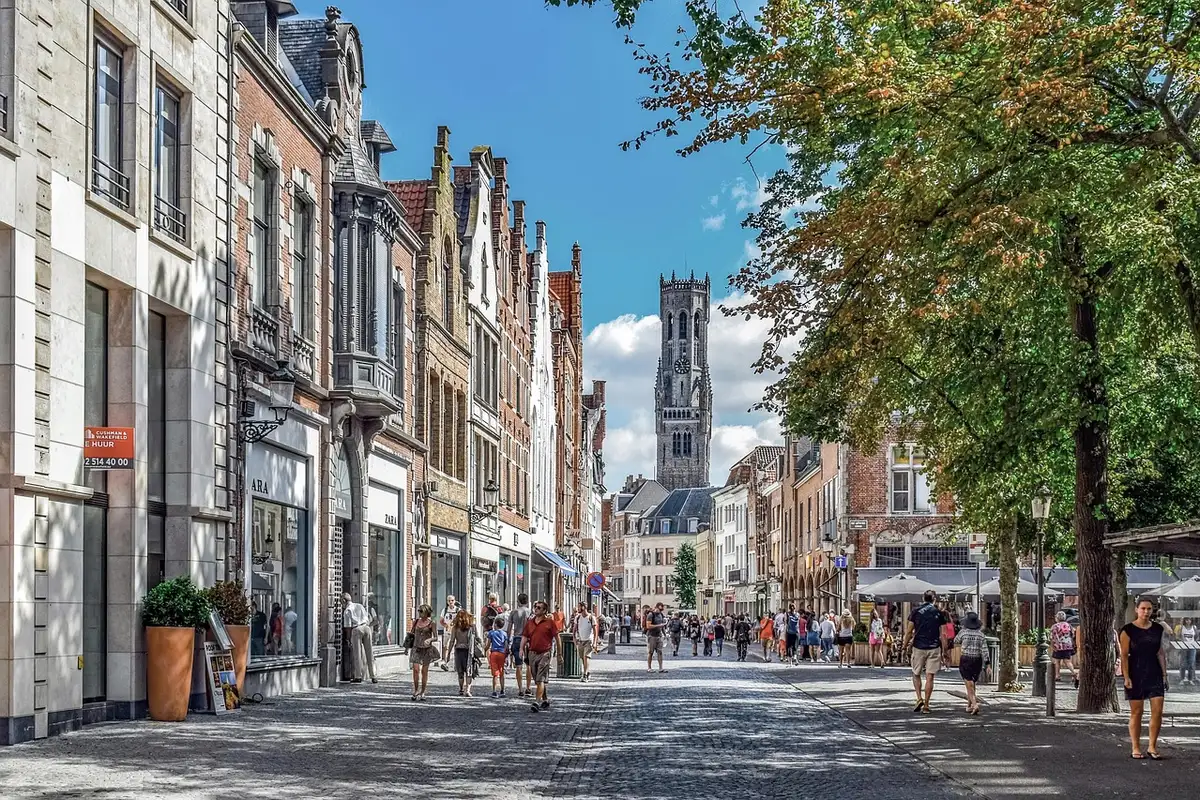
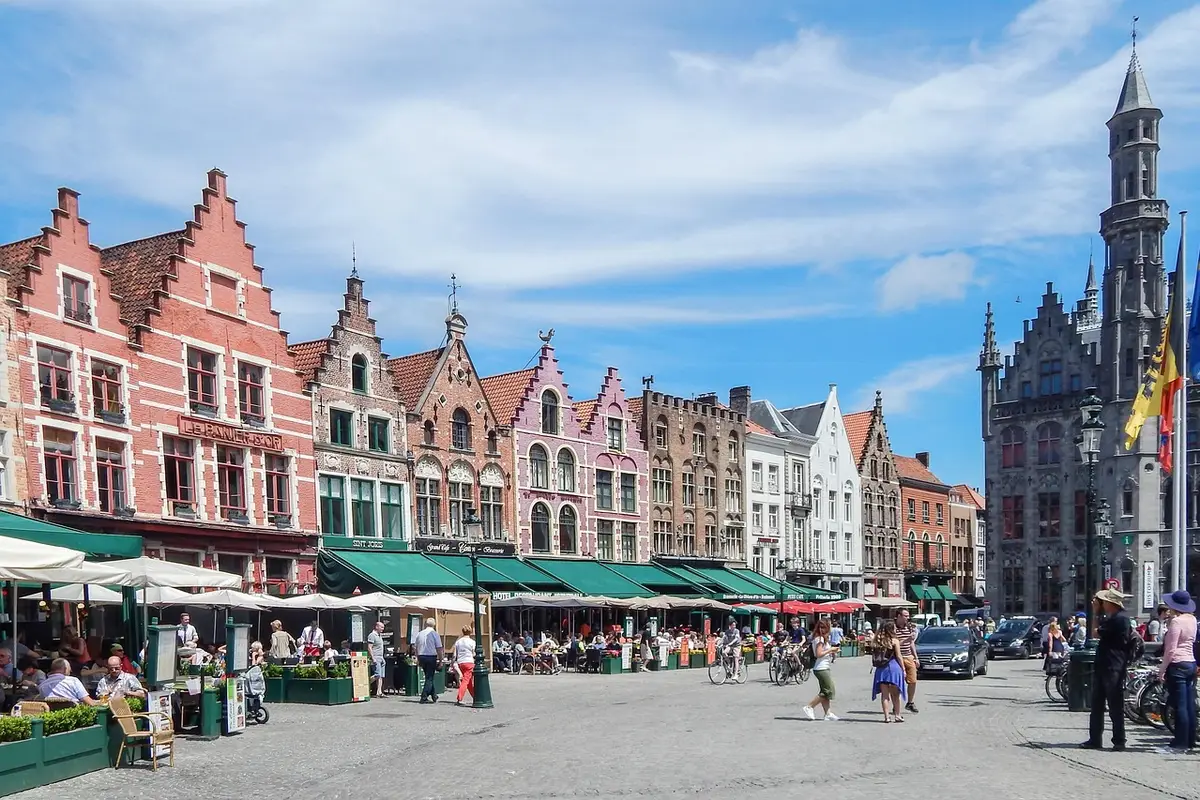
Start at the Markt (Market Square), the heart of the city, surrounded by colorful guild houses and the Belfort itself. From there, walk to the Burg, the neighboring square with the Basilica of the Holy Blood, then head down toward the canals for the boat ride. In the afternoon, set aside free time to get lost in the smaller streets like Wijngaardstraat and Groeninge, where the less touristy chocolate shops and studios are.
If you have more time, you can add the Beguinage (Begijnhof), a complex of white houses around a garden with poplar trees, listed by UNESCO along with the historic center; entry to the courtyard is free, though visiting the interior of one of the museum houses requires a separate ticket.
How much the canal boat ride costs
The canal boat ride costs €15 per adult and €9 per child aged 4 to 11, with children under 4 riding free and a discount for groups of 20 or more (prices valid through December 2026, according to the official Visit Bruges website). The ride lasts about 30 minutes with no stops and operates daily from March to October, 10am to 6pm, with the last departure half an hour before closing; from November to February, service is reduced.
Those 30 minutes go by fast for the price charged — past visitors complain on forums about long lines and little time on the boat, so go early or late in the day to cut down the wait at the boarding points, which are scattered around the center.
Is climbing the Belfort worth it?
Worth it if narrow stairs don’t bother you: tickets cost €16 for adults and €14 for youths aged 7 to 17 (free under 7), with a reduced winter rate — €15 adult and €13 youth — on weekdays between November 3 and March 31 (Apr 2026, Visit Bruges). The climb has 366 narrow spiral steps, no elevator, up to the 83-meter top.
The reward is the 360° view over the brick rooftops and canals — but anyone with claustrophobia or mobility issues should skip this part and enjoy the square below, since the tower isn’t wheelchair accessible.
Where to eat the best chocolate without falling for the tourist trap
The most common trap in Bruges is buying industrialized chocolate disguised as artisanal in the shops around the Markt, which sell imported products in pretty packaging for passing tourists. Chocolatiers with their own visible production, like Dumon and The Chocolate Line, sit a bit off the main circuit and are worth the detour — ask whether the chocolate is made in-house (handmade / maison) before buying, and prefer buying by weight over pre-assembled closed boxes.

For those who want more than just shopping, the combo ticket with the Choco-Story Museum plus a chocolate workshop teaches the history of cocoa in Belgium and lets you make your own bar on the spot — a 1.5 to 2-hour program that fits nicely into an afternoon day trip.
Is Bruges worth it or is it a tourist trap?
It’s worth it, but manage your crowd expectations: on travel forums like TripAdvisor, threads titled “Terrible Bruges” and “tourist trap” show that some of the criticism comes from people who visited on a weekend or during peak summer season, when the historic center gets packed with tour groups and excursion buses.
Outside those peaks, Bruges delivers what it promises: well-preserved medieval architecture, navigable canals, and a scale small enough that it won’t wear you out. The city works better as a day stop within a larger Belgium or Netherlands itinerary than as a multi-night destination.
Bruges or Ghent: which to choose for your day trip
If you only have time for one day trip from Brussels and you’re torn between Bruges and Ghent, check out the full comparison in Bruges or Ghent: which day trip to choose from Brussels — in short, Bruges is more photogenic and touristy, while Ghent has a more authentic vibe and fewer crowds.
Where to eat in Bruges
Avoid restaurants with multilingual laminated menus facing the Markt — those are the ones that charge the most for a tourist-sized portion. Streets like Sint-Amandsstraat and Philipstockstraat, just steps from the main square, have options of the same quality at fairer prices. Try the street Belgian waffle as a quick snack and save the fixed restaurant menu for lunch or the main dinner, with dishes like moules-frites (mussels with fries) or carbonade flamande (beer-braised beef stew).
Practical tips for the day
Wear comfortable shoes: Bruges’ cobblestone streets wear your feet out fast over a full day of walking. Bring cash or an international card with no fees, because not every small chocolatier accepts all cards. Leave plenty of buffer time for the train back to Brussels if you’re doing a day trip — the last departure is usually earlier than you’d think, so confirm the schedule as soon as you arrive in town.
If after Bruges your itinerary heads into the Belgian or Dutch countryside, it’s also worth checking out what to do in Rotterdam or The Hague, both a short train ride away.
Frequently asked questions
Is Bruges too crowded with tourists?
Bruges gets quite crowded on weekends and during peak summer season, especially around the Markt and the boat tour boarding points. Visiting on a weekday or outside the summer peak significantly reduces the feeling of crowds.
Can you visit Bruges as a 1-day trip from Brussels?
Yes, Bruges is a classic day trip from Brussels: the train takes about 1h to 1h10 each way, and the main historic center (Markt, Belfort, canals, a chocolate stop) fits into one day, though without rushing it’s better to set aside a full day.
What’s the best time to visit Bruges without crowds?
There’s no official source pinning down an exact month, but the pattern for similar European destinations points to fall and winter (outside the December Christmas market period) as the quieter times in Bruges.
Where is Bruges and how do you pronounce the name?
Bruges is in the West Flanders region, in northwestern Belgium, about 1 hour by train from Brussels. In Dutch the city is called Brugge, pronounced something like “broo-khuh”; “Bruges” is the French and English name, more widely used internationally.
Conclusion
A perfect day in Bruges is all about pacing: start early at the Markt and the Belfort, fit in the canal boat before the lines grow, and save the afternoon for finding the right chocolatier away from the most touristy circuit. For more itineraries through Belgium and neighboring countries, Voyage Voyage has more practical guides like this one.